
Service guide Business · Nation
Price a Service Around the Whole Job
Practice a pricing worksheet that includes delivery costs, your time, overhead, and realistic capacity.
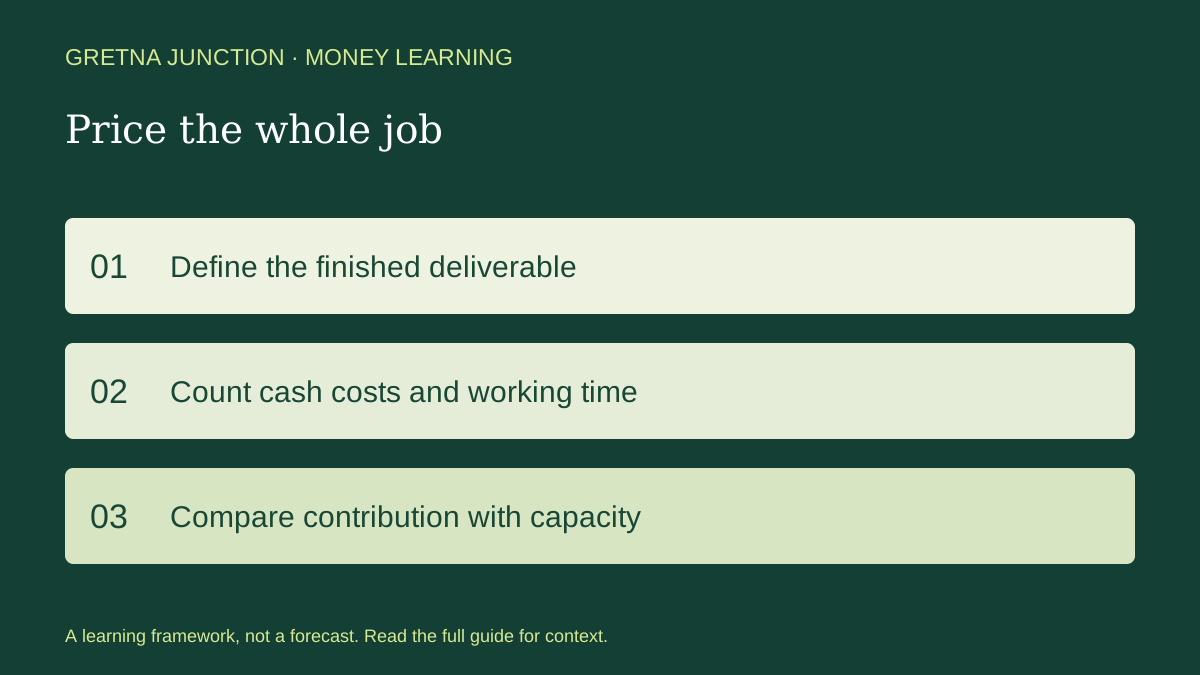
Image provenance · CIE 100/100
Assessment applies to the credited image record and its editorial context. Image delivery, pixels and the pictured event’s current status require separate verification. Receipt: 15b8a41e-c9e5-4948-92c4-834d18e098aa
Image & publication standards →In this story
Start with one clear unit
A service price is easier to examine when the buyer and seller can describe the same finished job. In this hypothetical Gretna Junction example, Dana offers one edited set of ten product photographs.
The package includes one planning call, one shooting session, one revision round, and delivery of agreed file sizes. Extra photographs are outside the example package.
This clear boundary gives Dana something measurable to price.
Write down the invisible work alongside the visible work. Dana expects an hour preparing and communicating, an hour taking photographs, and an hour editing and delivering.
A customer may see only the shoot, but three hours disappear from Dana's calendar. A price that ignores the other two hours can look attractive while producing a disappointing working day.
Work through the hypothetical numbers
Suppose Dana considers charging $120. The example assigns $24 to costs that arise with each completed job, including supplies, travel, and payment processing.
That leaves $96 before monthly overhead and compensation for Dana's work. Dana adds a planning allowance of $20 for each of the three working hours: $60 per job.
The remaining $36 contributes to overhead and any surplus.
That $60 is an economic planning allowance, not a statement about whether an owner's labor is a deductible expense or payroll. The example excludes taxes.
Using a labor allowance makes Dana ask whether the activity is worthwhile compared with other uses of time, even when no separate paycheck is issued.
Check the month and the calendar
The SBA describes break-even analysis as comparing fixed costs with the amount left from each sale after variable costs. Its calculation is an estimate, not a promise of demand.
SBA planning guide
For this practice model, assume $180 in monthly overhead and apply Dana's labor allowance before calculating the surplus. Five jobs at $36 each cover that $180.
At eight jobs, $288 remains after the per-job costs and labor allowances; subtracting $180 leaves $108 before tax and any omitted costs. These figures are invented teaching inputs, not local market prices.
Now test a $100 price with every other assumption unchanged. Only $16 remains per job after the $24 cost and $60 labor allowance.
Covering $180 takes twelve whole jobs because eleven produce just $176. If Dana can deliver only eight jobs that month, the lower price does not support this plan.
More orders would not fix a calendar that has no room for them.
Let evidence revise the offer
A worksheet cannot tell Dana what customers will buy. After each actual job, Dana can compare estimated hours with recorded hours and note revision requests.
If editing repeatedly takes longer, possible experiments include a smaller package, a clearer revision boundary, a different workflow, or a different price. Each choice changes what the customer receives, so communicate it before the next booking.
Keep a short decision note: the proposed price, assumed hours, expected number of jobs, and the condition that would make you reconsider. Avoid treating a competitor's price as proof that your costs match theirs.
The practical goal is to understand one offer well enough to explain its price and recognize when its assumptions stop holding.
Build a one-job worksheet
Choose one service and write its deliverables and revision boundary in one sentence.
List its per-job cash costs, all working hours, a hypothetical labor allowance, and monthly overhead.
Calculate the contribution at two possible prices, then compare the required job count with your actual calendar.
Which assumption would hurt the plan most if it were wrong: price, delivery time, cost, or demand?
About this learning guide
Gretna Junction desk education. Hypothetical examples are for practice, not personalized financial, tax, or legal advice.
No earnings are promised.
Cultural & community review
Assessment passed This recorded version passed its cultural and community assessment.
- Reviews the cultural and community context of this editorial item.
- Source, rights and publisher checks remain separate.
- It does not score people or certify every fact.
Read the assessment record & limits
- This record applies to the identified content revision. Later changes require another assessment.
- Asset
- gj:article:gj-money-service-pricing
- Engine
- ct.algorithm.cie.v1 · 1.0.1
- Receipt
- 62a1ff9d-0da1-4d13-b482-263621684f71
- Assessed
- Revision
- sha256-2571f0bd02b8210628e4ecaa67708bb52a29dc61db9ac3ae4325669625de0dda
- Record state
- eligible · PASS
- Binding
- BOUND
Sources & verification
Accessed 2026-09-19
Read the sourceThis article was written with AI assistance from the linked sources. No firsthand interview or visit is implied. Source dates and limits are identified in the reporting. Advertising does not determine editorial coverage. Request a correction or read our standards.
EVERY NEIGHBOR HAS A VOICE
Keep the conversation going.
Share experiences, ask questions and link evidence for factual claims. Automated publication checks apply to each submitted version. Comments are independent community discussion, not submissions to a government body.
Sign in to join · freeCommunity standards