
Service guide Business · Nation
Make Invoices Easy to Understand and Follow Up
Create a consistent administrative workflow for sending, checking, recording, and following up on invoices.
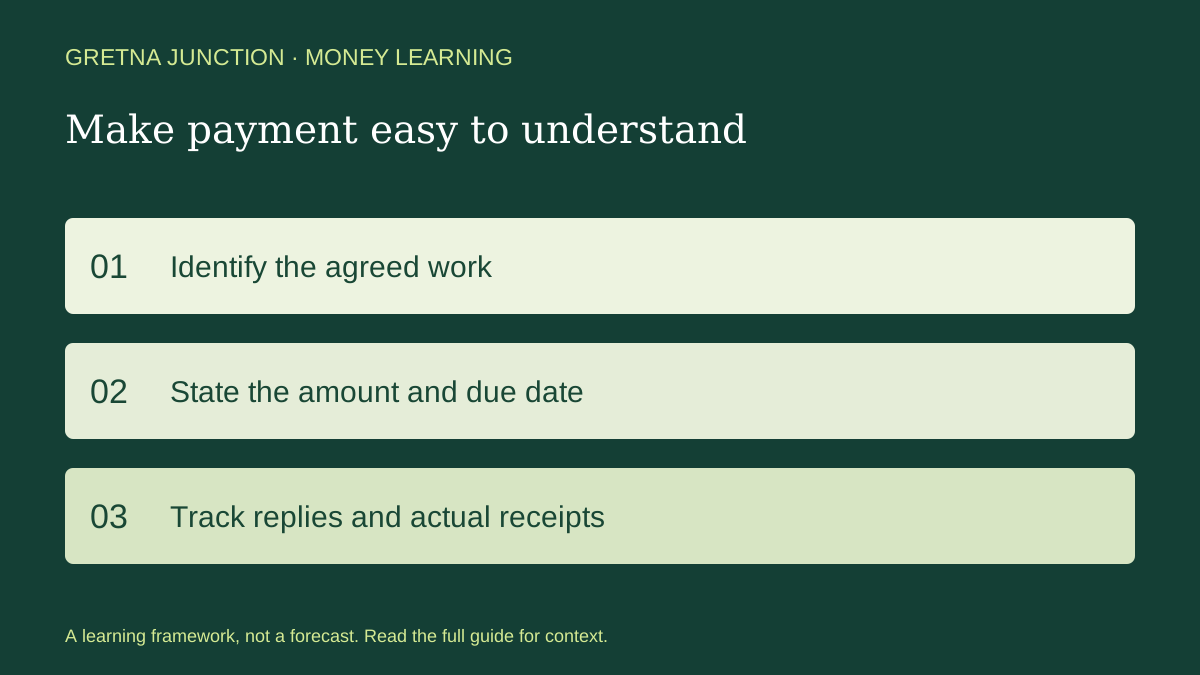
Image provenance · CIE 100/100
Assessment applies to the credited image record and its editorial context. Image delivery, pixels and the pictured event’s current status require separate verification. Receipt: 47c09e51-f5f7-4d3f-a9fd-27c2cbd56fca
Image & publication standards →In this story
Begin before the invoice exists
A useful invoice workflow begins while a job is being arranged. In this hypothetical example, Lee edits a short promotional video for a small business.
Before delivery, Lee confirms the billing contact, the buyer's reference number if one is needed, the agreed work, and the payment schedule. The aim is to prevent a completed job from sitting in the wrong person's inbox.
This lesson covers administrative habits. It does not supply a contract, decide whether a charge is legally enforceable, or establish rights to late fees, collection action, or stopping work.
Those questions depend on the agreement and applicable law. A clear workflow helps you identify the problem to take to a qualified professional when needed.
Make the amount traceable
Lee's hypothetical invoice has a unique number, an issue date, the correct customer name, and a short description of the agreed deliverable. It shows a $400 project charge, a previously received $100 payment, and a $300 remaining balance.
The due date matches the arrangement already discussed with the customer. Payment instructions use the method both parties expect.
The arithmetic should be easy for someone outside your business to check. A total that forgets an earlier payment creates unnecessary friction.
Avoid adding an unexplained fee during follow-up. If you discover a mistake, issue a clearly identified correction, keep a record of the change, and make sure the customer knows which version to use.
The IRS lists invoices and payment records among supporting business documents. Keep the invoice, evidence of payment, and related records together so the bookkeeping entry can be explained later.
IRS records guidance
Use a simple status list
For the practice workflow, Lee records six fields in a sheet: invoice number, customer, amount outstanding, due date, status, and next action. Status choices are drafted, sent, received by customer, partly paid, paid, or disputed.
“Sent” does not mean “paid.” A dated note is more useful than a colored cell whose meaning only you remember.
After sending the invoice, Lee checks that it reached the correct contact. If the due date passes, Lee first checks the bank and payment service so an already settled payment does not receive an unnecessary reminder.
Lee then sends a brief factual note naming the invoice, remaining amount, and original due date, asking whether anything is preventing processing.
Respond to the reason for the delay
Suppose the customer replies that a purchase reference was missing. Lee can add the agreed reference, confirm receipt, and record the new information.
If the customer instead disputes the scope, sending the same reminder repeatedly will not resolve that issue. Lee gathers the relevant project records and separates the disputed question from routine payment tracking.
Keep communication professional and private. An unpaid invoice is not a reason to publish a customer's details or threaten consequences that you have not verified.
If the issue persists, set a review point for professional guidance. Preserve the record of attempts and responses rather than relying on memory.
Close the loop when payment arrives
When the $300 arrives, Lee matches it to the invoice, records any processing deduction separately, and marks the remaining customer balance paid. Lee also checks that the next cash forecast reflects the money actually received.
If a payment cannot be matched, leave it flagged for investigation instead of guessing.
Finally, examine the process rather than blaming every delay on the customer. Repeated incorrect contacts may mean the intake form needs work.
Repeated scope disputes may mean deliverables need a clearer description. The strongest invoice system makes the ordinary path predictable and the unusual case visible.
Trace a practice invoice
Create a fictional $400 invoice with a $100 payment already credited.
Add it to a status sheet with a due date and next action.
Draft a neutral reminder for the $300 balance and a separate note recording a customer response.
Could another person understand the amount, status, and next step without asking you?
About this learning guide
Gretna Junction desk education. Hypothetical examples are for practice, not personalized financial, tax, or legal advice.
No earnings are promised.
Cultural & community review
Assessment passed This recorded version passed its cultural and community assessment.
- Reviews the cultural and community context of this editorial item.
- Source, rights and publisher checks remain separate.
- It does not score people or certify every fact.
Read the assessment record & limits
- This record applies to the identified content revision. Later changes require another assessment.
- Asset
- gj:article:gj-money-invoice-workflow
- Engine
- ct.algorithm.cie.v1 · 1.0.1
- Receipt
- fe3100a6-3ea3-45be-b988-9dcc6a089ab5
- Assessed
- Revision
- sha256-8937133a4f40b44056f171af489bc6bd0e6ac3ef06b2b6bbe0c0ba920892f1d8
- Record state
- eligible · PASS
- Binding
- BOUND
Sources & verification
Accessed 2026-09-19
Read the sourceThis article was written with AI assistance from the linked sources. No firsthand interview or visit is implied. Source dates and limits are identified in the reporting. Advertising does not determine editorial coverage. Request a correction or read our standards.
EVERY NEIGHBOR HAS A VOICE
Keep the conversation going.
Share experiences, ask questions and link evidence for factual claims. Automated publication checks apply to each submitted version. Comments are independent community discussion, not submissions to a government body.
Sign in to join · freeCommunity standards