
Service guide Business · Nation
A Profitable Job Can Still Leave You Short of Cash
Use a simple timing example to separate operating results, available cash, and unpaid customer balances.
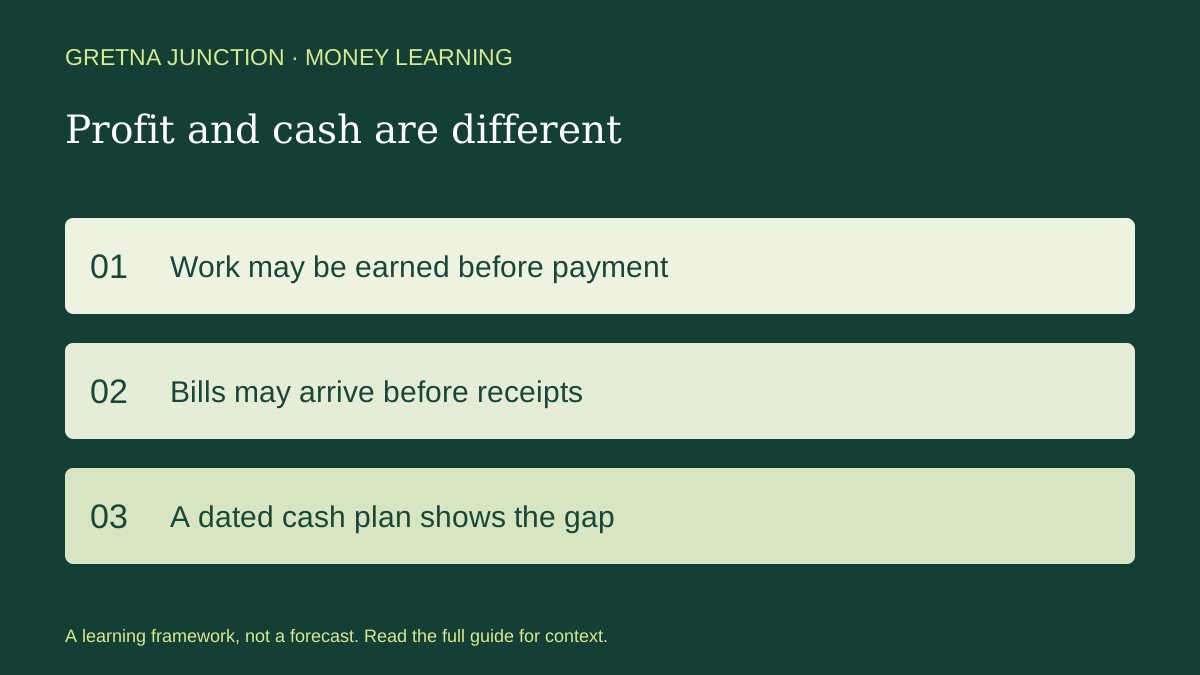
Image provenance · CIE 100/100
Assessment applies to the credited image record and its editorial context. Image delivery, pixels and the pictured event’s current status require separate verification. Receipt: 5998811e-5fe3-4348-bcad-c6de66498f45
Image & publication standards →In this story
Ask two different questions
Imagine a small design business near Gretna Junction finishing a $900 project. The owner wants to know whether the job was worthwhile and whether there is enough money for next week's bills.
Those questions use related information, but they are different. One examines the result of the work.
The other examines money that is available when a payment must be made.
Accounting methods also affect when income and expenses appear in records. IRS Publication 538 explains that cash and accrual methods generally recognize transactions at different times.
Tax accounting has additional rules; the exercise below is a management example, not instructions to adopt or change a tax method. IRS Publication 538
Follow a hypothetical month
Suppose the project has $250 in direct costs and this simplified month has $100 in other operating expenses. Assume all $900 of project revenue is earned this month, with all $350 of related expenses counted this month.
On that stated basis, the example operating profit is $550. For teaching clarity, there are no other sales, expenses, equipment purchases, taxes, or owner withdrawals.
Now follow the bank balance. The month begins with $200.
The customer pays $300 now and owes the remaining $600 later. The business pays the $250 and $100 expenses now.
Ending cash is $200 plus $300 minus $350, or $150. A $550 operating result and $150 of available cash can coexist because part of the earned revenue has not arrived.
If an additional $200 bill must be paid before the customer's balance arrives, the business faces a $50 timing gap. Calling the project profitable does not settle that bill.
Equally, the timing gap alone does not prove that the project's price was wrong. It shows exactly which date and payment assumption need attention.
Build a view that follows dates
On a sheet, give each upcoming week four lines: opening cash, expected receipts, planned payments, and closing cash. Carry each closing amount into the next week.
Put the customer's $600 in the week you reasonably expect it to clear, rather than the week you wish it would arrive. Label that receipt uncertain until payment is confirmed.
Make a second version in which the $600 arrives one week later. The difference between the two versions helps identify the earliest problem.
You might then investigate a corrected invoice, an agreed staged payment for future work, or moving an optional purchase. These are questions to evaluate against real commitments, not automatic instructions to borrow or delay a required payment.
Do not confuse funding with performance
If the owner puts another $500 into the bank account in this example, cash rises from $150 to $650. The project has not suddenly earned another $500 from customers.
Label the transfer so the business's operating performance remains visible. Likewise, receiving a loan would create cash and a repayment obligation; it would not turn the borrowed amount into sales.
The SBA recommends keeping track of receivables, payables, available cash, and bank reconciliation. A short weekly review can bring those views together.
SBA management guide
At your review, ask what changed since the last forecast. Did a customer pay, did a charge settle, or did an expected sale remain only a conversation?
Update the dates and amounts. A forecast is useful because you revise it when evidence changes, not because its first version predicts everything.
Move one receipt
Copy the example into a four-week cash sheet, starting with $200.
Enter the $300 receipt and $350 payments, then schedule the $600 balance.
Move the $600 one week later and highlight any week whose closing cash falls below zero.
Which payment date would you verify first, and what evidence would count as confirmation?
About this learning guide
Gretna Junction desk education. Hypothetical examples are for practice, not personalized financial, tax, or legal advice.
No earnings are promised.
Cultural & community review
Assessment passed This recorded version passed its cultural and community assessment.
- Reviews the cultural and community context of this editorial item.
- Source, rights and publisher checks remain separate.
- It does not score people or certify every fact.
Read the assessment record & limits
- This record applies to the identified content revision. Later changes require another assessment.
- Asset
- gj:article:gj-money-cash-flow-profit
- Engine
- ct.algorithm.cie.v1 · 1.0.1
- Receipt
- 6071050c-0bfd-48e5-8c12-67fe7034e975
- Assessed
- Revision
- sha256-fefcc39d6003b5864b17a9caa49a4603a58b3373189002920b215ae4a6c62795
- Record state
- eligible · PASS
- Binding
- BOUND
Sources & verification
January 2022 publication version. Accessed 2026-09-19
Read the sourceAccessed 2026-09-19
Read the sourceThis article was written with AI assistance from the linked sources. No firsthand interview or visit is implied. Source dates and limits are identified in the reporting. Advertising does not determine editorial coverage. Request a correction or read our standards.
EVERY NEIGHBOR HAS A VOICE
Keep the conversation going.
Share experiences, ask questions and link evidence for factual claims. Automated publication checks apply to each submitted version. Comments are independent community discussion, not submissions to a government body.
Sign in to join · freeCommunity standards