
Service guide Business · Nation
Keep Business Money Legible
Practice a simple recordkeeping routine that separates customer revenue, fees, owner transfers, and supporting documents.
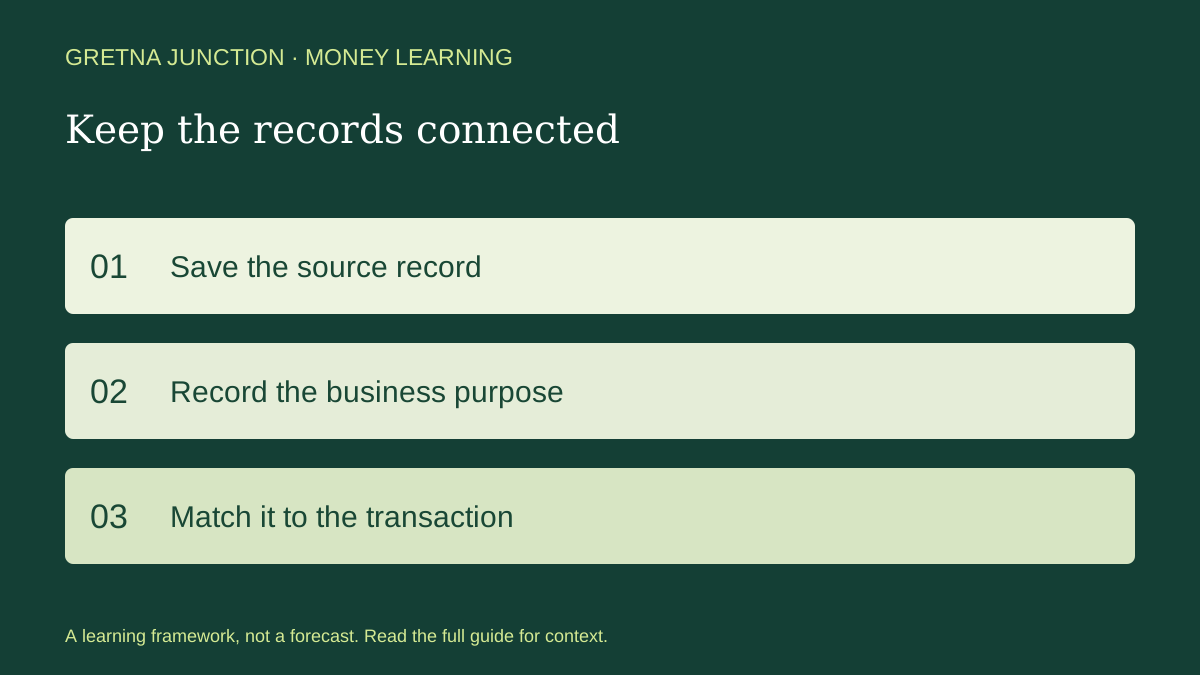
Image provenance · CIE 100/100
Assessment applies to the credited image record and its editorial context. Image delivery, pixels and the pictured event’s current status require separate verification. Receipt: ec366f25-15e7-4b5e-9361-64643330ad0c
Image & publication standards →In this story
Aim for an explainable record
Bookkeeping begins with a practical test: could you explain each entry to someone who was not there when the money moved? In a hypothetical Gretna Junction business, Casey sells small design services.
A bank feed shows deposits and withdrawals, but it does not always show which job was paid, whether a transfer came from Casey, or why a purchase was made.
The IRS says a recordkeeping system should clearly show business income and expenses, supported by documents such as invoices and receipts. Choose a method that you can maintain and retrieve, rather than assuming the most complicated software creates the clearest records.
IRS records guidance
Separate the flows
The SBA recommends a business account when you begin accepting or spending money as a business. Compare the account's fees, transaction rules, and required documents with your activity.
Separation can make records easier to follow; an account alone does not determine legal liability or tax treatment. SBA launch guide
In this original example, Casey receives $200 for a finished project. A payment processor keeps an invented $6 fee and deposits $194.
The working record shows $200 of customer revenue, a $6 processing expense, and the $194 bank deposit connected to that transaction. Recording only the net deposit would hide part of the transaction's story.
Now suppose Casey transfers $100 of personal money into the business account. That deposit is not another customer sale.
Casey identifies it as an owner transfer pending the correct classification for the business structure. The record should preserve what happened even if a bookkeeper later adjusts the account name.
Never force every unexplained deposit into sales simply to clear a review queue.
Keep the evidence near the entry
For each practice entry, Casey records a date, amount, payer or payee, short purpose, category, and document reference. A filename such as an invoice number or receipt date creates a path back to the evidence.
If one receipt includes personal and business items, flag the mixed purchase and document the business portion rather than treating the full amount as automatically deductible.
Build an “ask” list for unclear transactions. A useful question contains the actual facts: what was purchased, when, for what purpose, and which document supports it.
This is more helpful than asking whether “everything” can be written off. An unresolved item is a review task, not a reason to invent a category.
Make a small routine repeatable
The IRS notes that electronic records must meet the same basic requirements as paper records and remain complete, accurate, and accessible. Keep usable exports and supporting files rather than assuming continued access to a single app is enough.
IRS transaction-recording guidance
Casey chooses a short weekly appointment to attach documents and identify unusual entries. At month-end, Casey compares the records with account statements and investigates differences, including timing differences and duplicated entries.
For the example payment, the deposit should reconcile to $194, while the linked sales and fee entries explain how it reached that amount.
Create a useful handoff
At the end of the month, Casey prepares a compact packet: the transaction summary, account statements, supporting documents, and the unanswered question list. This lets a bookkeeper or tax professional spend more time resolving actual issues and less time asking what a mysterious charge means.
A tidy record is not proof that every expense qualifies for a deduction. It is the information needed to make and support the appropriate decision.
The routine should help you understand the business during the year as well as prepare for later reporting. Start with a method you can use consistently, then improve it when a real problem appears.
Explain three transactions
Record a fictional $200 customer sale, a $6 processor fee, and the resulting $194 deposit.
Add a separate $100 owner transfer and label it so it is not counted as another sale.
Assign document references and write one question that would need a bookkeeper's review.
Could someone trace the bank deposit back to the customer sale without guessing?
About this learning guide
Gretna Junction desk education. Hypothetical examples are for practice, not personalized financial, tax, or legal advice.
No earnings are promised.
Cultural & community review
Assessment passed This recorded version passed its cultural and community assessment.
- Reviews the cultural and community context of this editorial item.
- Source, rights and publisher checks remain separate.
- It does not score people or certify every fact.
Read the assessment record & limits
- This record applies to the identified content revision. Later changes require another assessment.
- Asset
- gj:article:gj-money-bookkeeping-separation
- Engine
- ct.algorithm.cie.v1 · 1.0.1
- Receipt
- 03d48144-866e-4e0d-91e1-a02155f93296
- Assessed
- Revision
- sha256-5b7165ebffea9fe020a531d2b169ff3c9bc49b388cd48f8147115bc12305ab85
- Record state
- eligible · PASS
- Binding
- BOUND
Sources & verification
Accessed 2026-09-19
Read the sourceAccessed 2026-09-19
Read the sourceAccessed 2026-09-19
Read the sourceThis article was written with AI assistance from the linked sources. No firsthand interview or visit is implied. Source dates and limits are identified in the reporting. Advertising does not determine editorial coverage. Request a correction or read our standards.
EVERY NEIGHBOR HAS A VOICE
Keep the conversation going.
Share experiences, ask questions and link evidence for factual claims. Automated publication checks apply to each submitted version. Comments are independent community discussion, not submissions to a government body.
Sign in to join · freeCommunity standards