
Service guide Business · Nation
Test a Side Business Before Spending the Whole Budget
Design a small, bounded experiment that tests a customer problem while protecting a limited starting budget.
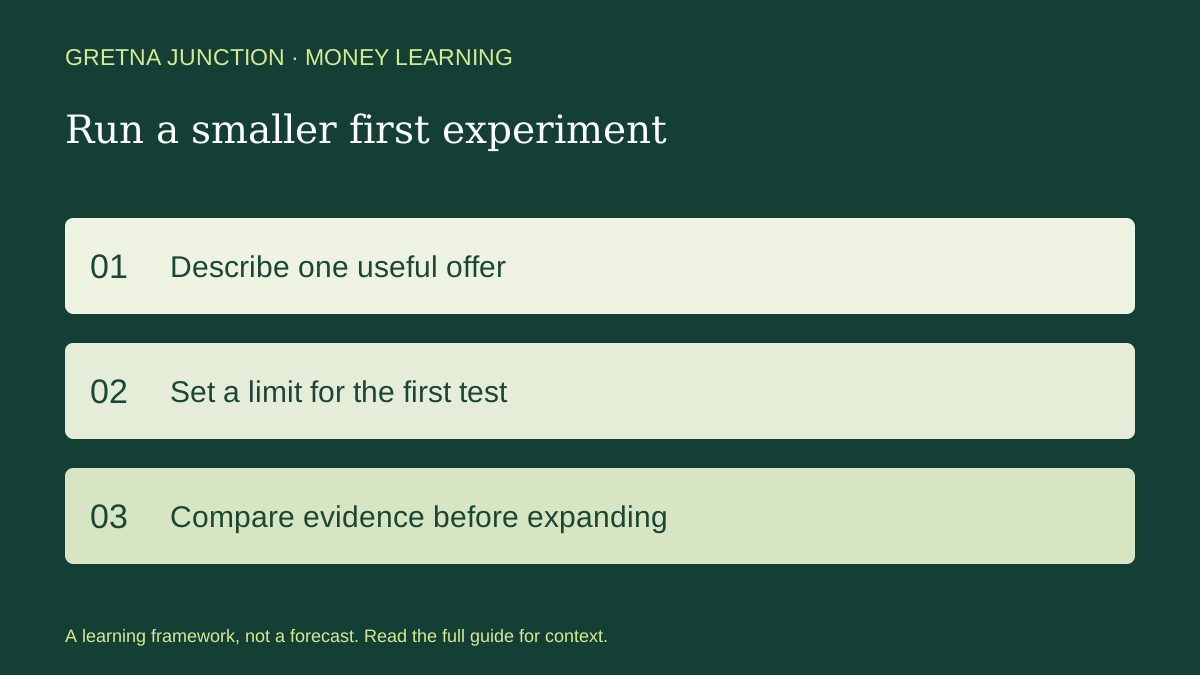
Image provenance · CIE 100/100
Assessment applies to the credited image record and its editorial context. Image delivery, pixels and the pictured event’s current status require separate verification. Receipt: 4c070670-63bf-44cb-9439-ab01a463af23
Image & publication standards →In this story
Choose a question small enough to answer
A side business can begin with a question more useful than “Can I become an entrepreneur?” Try “Will a specific type of customer pay for this clearly described result?”
A small test gives you a chance to learn before committing to equipment, subscriptions, or a large stock of goods. It can also reveal that the proposed work does not fit the time you have.
Consider a hypothetical creator in Gretna Junction who already knows basic page design. Morgan is considering a service that turns customer-supplied information into a one-page event flyer.
Morgan's first question is whether potential customers struggle with the layout enough to consider paying for help. The test is not evidence that every local organization needs the service.
Separate discovery from delivery
Morgan starts with five voluntary conversations. Instead of asking whether the idea sounds good, Morgan asks how the person handled their most recent flyer, what took the most time, and whether they paid anyone.
A concrete past experience is easier to examine than a polite promise about an imaginary purchase. Morgan writes down answers without adding the person to a mailing list without consent.
The SBA connects market research with understanding demand and alternatives. It also recommends estimating startup expenses before launch.
These principles support a small test, but they do not establish that a particular business will succeed. SBA planning guide
Next, Morgan makes one clearly labeled sample using original text and images that Morgan has permission to use. The sample demonstrates a deliverable.
It is not a fake client project or testimonial. Morgan can ask whether the sample solves the problem identified in the conversations, then revise the offer before accepting work.
Put a ceiling on the experiment
Suppose Morgan has $150 available for this experiment after protecting household necessities. An invented worksheet assigns $20 to sample materials, $35 to basic supplies, $15 to travel, $30 to a rework contingency, and leaves $50 uncommitted.
This is a math exercise, not a claim that $150 covers starting a business in Virginia. Existing equipment, software permissions, insurance, registration, and other requirements may change the actual total.
The SBA notes that license and permit requirements depend on activity and location. Before selling, verify the rules that apply to your specific Virginia address and service.
A small budget does not remove those requirements. SBA launch guide
If the necessary costs exceed Morgan's ceiling, one valid result is to pause, redesign the test, or keep it at the unpaid research stage. Do not quietly turn a spending ceiling into permission to put the remainder on credit.
Record the reason for any change so it is a deliberate decision.
Define success without promising income
Morgan writes a test goal: understand five recent customer experiences, complete one sample, and learn the time needed to produce it. A later paid pilot would add questions about delivery quality, revisions, payment, and actual costs.
The goal is useful evidence. A sale would be encouraging, but one sale would not establish stable demand or a dependable wage.
The FTC warns that guaranteed earnings and high-pressure business coaching offers can signal scams. Treat a promise that you can skip customer research or earn automatically as a reason to slow down and investigate.
FTC business-opportunity guidance
End the experiment with a decision date. Compare what you learned with what you spent and the hours you used.
You can continue, change the offer, or stop. Keeping an unspent balance and learning that an idea is unsuitable can be a successful experiment.
Write a $150 practice plan
Invent a service you could demonstrate with skills and equipment you already have.
Allocate a hypothetical $150 without assuming that the amount covers required launch costs.
Name one customer question, one sample, one spending ceiling, and one decision date.
What result would persuade you to stop or redesign the test before spending more?
About this learning guide
Gretna Junction desk education. Hypothetical examples are for practice, not personalized financial, tax, or legal advice.
No earnings are promised.
Cultural & community review
Assessment passed This recorded version passed its cultural and community assessment.
- Reviews the cultural and community context of this editorial item.
- Source, rights and publisher checks remain separate.
- It does not score people or certify every fact.
Read the assessment record & limits
- This record applies to the identified content revision. Later changes require another assessment.
- Asset
- gj:article:gj-money-small-budget-business
- Engine
- ct.algorithm.cie.v1 · 1.0.1
- Receipt
- 682667dc-e460-4dc2-bf1b-e7b1a3cc48d3
- Assessed
- Revision
- sha256-b366fcd4b8aa4bfd1ed37529c758d85429c8bffc8fa4783c4f2f08fa1b61fa40
- Record state
- eligible · PASS
- Binding
- BOUND
Sources & verification
Accessed 2026-09-19
Read the sourceAccessed 2026-09-19
Read the sourceAugust 2022 source publication. Accessed 2026-09-19
Read the sourceThis article was written with AI assistance from the linked sources. No firsthand interview or visit is implied. Source dates and limits are identified in the reporting. Advertising does not determine editorial coverage. Request a correction or read our standards.
EVERY NEIGHBOR HAS A VOICE
Keep the conversation going.
Share experiences, ask questions and link evidence for factual claims. Automated publication checks apply to each submitted version. Comments are independent community discussion, not submissions to a government body.
Sign in to join · freeCommunity standards