
Historical analysis Work & business · City
The workday beyond the mill: what Schoolfield’s buildings reveal about Danville’s company-town economy
A school complex, clinic, dormitory and surviving mill show how one employer shaped daily life, while the official record also documents racial exclusion and major losses.
Checking whether this browser can read the story aloud.
Explore related topics
Sources & editorial review
Sites editorial review recorded for this exact revision. This AI-assisted article or learning resource includes source links and credited contextual imagery.
This is a local editorial review, not a canonical Cultural Imprint Engine assessment. No CIE score is claimed. Source review does not verify third-party playback, provider availability or image pixels.
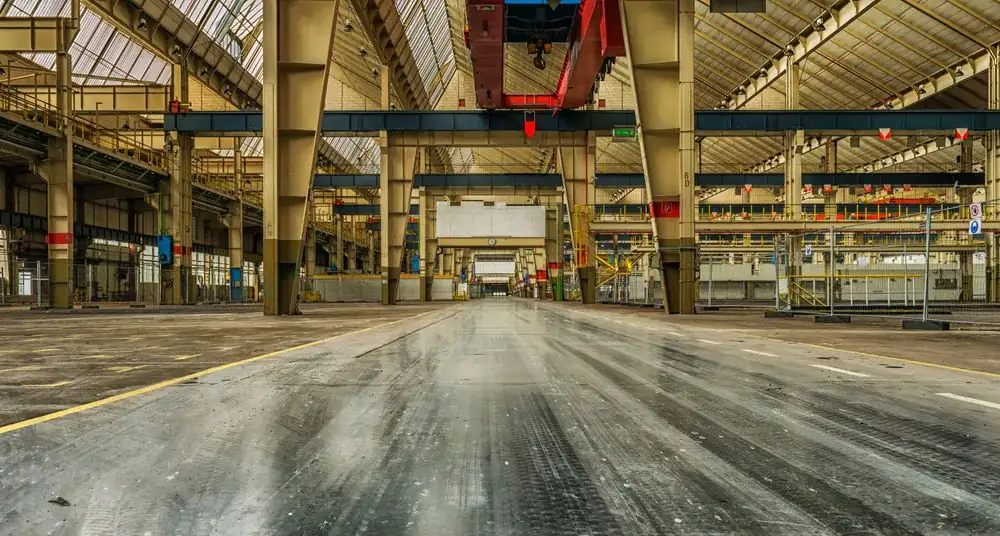
Photograph · source and license
The image, credit, reuse license, editorial context and delivered file are recorded in the exact Sites editorial review. This review is separate from the article’s canonical CIE assessment.
Image and publication standards →In this story
The factory gate was only one boundary
A factory can be remembered through the product that left its doors. Danville’s textile story also runs through the places workers returned to when a shift ended: housing, schools, a clinic, meeting rooms and a dining hall.
Those buildings make an economic argument visible. Work depended on a community capable of feeding, sheltering, caring for and educating people.
The mill itself was one part of that system, even when the company held much of the power over the other parts.
The Virginia Department of Historic Resources describes Schoolfield as a company town developed southwest of downtown Danville beginning in 1903. Its district includes industrial, residential, commercial and community buildings.
That official description provides the framework for this article. Separate DHR entries establish the dates and functions of the school complex, Welfare Building, Hylton Hall and White Mill.
Together, they support a history of work that extends beyond production totals without inventing individual workers’ experiences.
Reading this landscape requires two questions at once. What did the employer provide?
Who could use what it provided? The first can explain material investment; the second prevents a comfortable architecture story from obscuring unequal access.
The buildings cannot answer every question about pay, bargaining power or household life. They can show where those questions belong, and why a serious account of local business needs both production and social infrastructure.
A neighborhood designed around an employer
DHR’s district entry identifies approximately 512 acres and 1,005 historical buildings. It describes a commercial core and wood-frame workers’ housing, and says professional planning beginning in 1917 helped move the mill out of the residential landscape’s visual center.
Planting and structures could obscure views of the industrial buildings. That was a physical planning decision, not evidence that the employer’s influence disappeared from everyday life.
Our interpretation is that this separation between appearance and dependence deserves attention. A pleasant residential street can reduce the visual presence of production while remaining economically attached to it.
A household’s connection to a company may operate through a paycheck, tenancy, transport or services rather than a visible smokestack. Looking only for the biggest building therefore misses how a work-centered settlement operates.
For today’s reader, the useful comparison is a question rather than a claim of historical equivalence. When a major employer expands, what happens outside its property line?
A job announcement can specify positions while saying little about child care, commuting or housing capacity. Schoolfield supplies a local reason to examine those connections.
It does not prove that a contemporary employer has adopted a company-town model, nor that any new project will produce the same benefits or harms.
The clinic and child-care building belonged to the economy
Completed in 1917, the Schoolfield Welfare Building offered millworkers meeting space, child-care facilities and a clinic upstairs, according to its individual DHR entry. Its architectural description combines Mission and Classical Revival forms.
A separate log playhouse, built in 1938 for a kindergarten, is included in the listing. These details establish concrete services and spaces; they do not tell us how every family evaluated the arrangements.
The economic significance is easier to see when child care is treated as infrastructure. A workplace requires someone to arrive ready for a shift.
That arrival can depend on another person supervising a child, on a predictable handoff and on a reachable place for care. A clinic similarly connects a productive workplace to the capacity to seek attention for illness or injury.
The presence of those functions in one company-linked building makes their relationship to employment especially legible.
This interpretation should not turn the building into an unqualified endorsement of employer paternalism. Provision and dependence can coexist.
A service may meet a genuine need while giving its provider influence over people who use it. Evaluating that balance would require records about administration, eligibility, cost and worker response.
The building’s purpose is documented; the full experience of its users remains a larger research question.
A dormitory connected housing to a workforce
Hylton Hall adds another piece. DHR dates the six-story building to 1918 and identifies its original role as a residence for single female millworkers.
Dining, a social hall and recreation facilities were part of the arrangement. The hall remained residential until its conversion to offices in 1948.
DHR also records its later destruction: after a severe fire in 2012, the vacant building was demolished. It is a documented lost place, not a destination visitors can enter today.
A dormitory does more than supply beds. As an economic arrangement, it links access to work with a particular way of living.
Shared facilities can reduce the need for each resident to arrange meals and recreation independently. They also create rules and relationships unlike those of an unrelated private home.
Those are analytical implications of the building’s stated functions, not reconstructed testimony from its residents.
The loss matters because physical evidence and historical knowledge travel on different timelines. A building can disappear while an official description, photographs and nomination remain.
Conversely, an old photograph can preserve an exterior while saying little about the routines inside. For a local business history, both forms of evidence are valuable, but neither should be treated as a complete account of a working woman’s choices, independence or experience.
Education made the settlement more than a collection of houses
The Schoolfield School Complex contains three buildings constructed between 1913 and 1940. DHR identifies the Prairie Style Building A and architect Charles G.
Pettit Jr. Its entry describes the company’s provision of a neighborhood with housing, stores, churches, fire protection, public works and education. It also dates Schoolfield’s annexation by Danville to 1951.
These facts place schooling within a settlement that changed its relationship to city government over time.
Education belongs in a work history because households plan over years, not only over shifts. A job might attract a worker immediately, while a school helps determine whether a family can build a durable routine nearby.
Buildings constructed over several decades also suggest that the settlement was not simply a finished package installed on one opening day. The school complex’s date range is a reason to examine sequence and adjustment.
There is a contemporary reporting lesson here. An employer’s opening date is not the completion date for all the surrounding community needs.
A neighborhood may grow faster than its services, or inherit buildings whose uses change. The responsible question is how those systems develop and who maintains them.
Schoolfield’s school buildings provide a specific historical starting point for that inquiry without supplying a forecast for a present redevelopment.
Racial exclusion is part of the business model’s record
DHR’s Schoolfield district account explicitly states that company employment and housing policies excluded African Americans. It also describes an experiment in industrial democracy between 1919 and 1930.
Those statements must be read together. A scheme presented as giving workers a voice cannot be understood adequately without considering who was prevented from becoming one of those workers or residents.
The distinction changes how benefits should be described. A clinic, school or residence can be a significant investment and still belong to a system with exclusionary boundaries.
Saying that a company provided services is therefore only the beginning of the account. The reach of those services, the eligibility rules and the people left outside determine what the investment meant for the wider city.
This is not a claim that every surviving building had the same admissions practice, or that an individual worker held a particular belief. Such claims would need their own records.
It is an acknowledgment of a documented company-level exclusion in the district’s history. A local economic narrative becomes more accurate when it states that limitation plainly instead of allowing attractive architecture or a broad phrase about community welfare to stand in for universal opportunity.
The production landscape also had many working parts
The Riverside Division entry describes an industrial complex that once included cotton mills, a flour mill, dams, warehouses, a dye house, machine shop, research building and supporting power infrastructure. DHR records extensive demolitions and removal of the district from the state and national registers.
It distinguishes the separately listed Mill No. 8 on the river’s south side. These are different preservation histories, not interchangeable labels for one intact complex.
That inventory makes production look less like a single machine and more like a chain of coordinated functions. Manufacturing required energy, maintenance, storage, movement and technical development.
A dye house and machine shop imply different activities even when both belonged to the same company. This is our interpretation of the listed functions; it does not reconstruct staffing totals, operating costs or a specific day’s output.
For a small-business reader, the analytical value is the attention to dependencies. A visible product hides supporting work that is easier to overlook until it fails.
Maintenance, supply storage and reliable power do not become irrelevant because customers mainly see finished cloth. The district’s history therefore helps explain why an employer’s footprint can be larger than its best-known product line, and why an economic transition involves more than finding a new use for one building.
The White Mill preserves scale without preserving an entire industry
DHR dates Dan River Mill No. 8, commonly called the White Mill, to construction in 1920 and operation from 1921 into the 1990s. Its entry describes a five-story structure, a site exceeding 18 acres and a simplified Gothic Revival design.
Those facts make its scale concrete. They do not establish a current tenant, public access arrangement, vacancy or contemporary employment total.
A surviving mill can carry several stories at once. It can demonstrate industrial ambition through size and design.
It can become a focal point for memory because surrounding buildings were lost. It can also attract new plans because an existing structure presents possibilities that an empty site does not.
Those possibilities are not completed outcomes. A historic listing describes significance; it is not a certificate that a new business use has opened or succeeded.
The difference is practical for readers encountering redevelopment announcements. Proposed space, construction work, signed leases, occupied rooms and sustained employment are separate stages.
An article should name the stage supported by its evidence. In this historical account, the firmest contribution is explaining what the surviving building once did and how it relates to the larger production landscape, while leaving contemporary operating claims to current project records.
Downtown prosperity and the limits of a skyline
The Downtown Danville Historic District entry describes a commercial and administrative center containing retail, banks, hotels, theaters, lodges and tobacco factories. It identifies the monumental scale and architectural sophistication associated with the city’s historic prosperity.
This provides a useful counterpoint to Schoolfield: an industrial economy also left marks in downtown commerce and administration, beyond the place where a particular millworker lived.
A skyline, however, is a selective economic record. Large buildings are easier to recognize than a household budget or a worker’s unpaid caring responsibilities.
Surviving commercial architecture may testify to investment without revealing how that investment was distributed. The comparison between downtown buildings and the company settlement is useful precisely because neither district tells the whole story alone.
One shows institutions and commerce; the other brings the provision and control of daily life into view.
NC State’s textile-history page offers another caution about snapshots. It summarizes a 1982 industry account of Dan River’s modernization and capital investment during the preceding decade.
That contemporary celebration belongs to its own moment. A later closure does not erase earlier investment, and earlier investment does not prove permanent security.
Business history needs dates beside achievements because prosperity, adaptation and vulnerability can belong to different chapters of the same company.
A local way to evaluate work that lasts
Schoolfield’s record suggests a durable reporting approach: follow the connections between the job and the life that makes the job possible. The clinic, school and dormitory do not supply a universal template to copy.
They reveal why care, education and housing belong in a serious account of employment. The exclusion documented by DHR makes clear that the reach of a service matters as much as its existence.
For someone researching family or neighborhood history, the next useful step is specific. Begin with the building or institution that connects to the question, then distinguish its documented function from a personal account that still needs evidence.
A photograph of a school can be paired with a verified date; a recollection about attendance should retain its speaker and limitations. Neither needs to be inflated into a story about every worker.
The result is a fuller understanding of Danville’s economic landscape. Work created cloth and income, but it also organized space, services and access.
Some buildings remain, others survive only in records, and each carries different evidence. Holding those differences together allows the city’s company-town history to inform present questions about opportunity without replacing them with nostalgia, a promised redevelopment outcome or an invented account of life inside the mill.
Sources & verification
Primary source checked October 10, 2026. Source dates, documented facts and limitations are identified in the article; interpretation and hypothetical examples are separate.
Read the sourcePrimary source checked October 10, 2026. Source dates, documented facts and limitations are identified in the article; interpretation and hypothetical examples are separate.
Read the sourcePrimary source checked October 10, 2026. Source dates, documented facts and limitations are identified in the article; interpretation and hypothetical examples are separate.
Read the sourcePrimary source checked October 10, 2026. Source dates, documented facts and limitations are identified in the article; interpretation and hypothetical examples are separate.
Read the sourcePrimary source checked October 10, 2026. Source dates, documented facts and limitations are identified in the article; interpretation and hypothetical examples are separate.
Read the sourcePrimary source checked October 10, 2026. Source dates, documented facts and limitations are identified in the article; interpretation and hypothetical examples are separate.
Read the sourcePrimary source checked October 10, 2026. Source dates, documented facts and limitations are identified in the article; interpretation and hypothetical examples are separate.
Read the sourcePrimary source checked October 10, 2026. Source dates, documented facts and limitations are identified in the article; interpretation and hypothetical examples are separate.
Read the sourceThis article was written with AI assistance from the linked sources. No firsthand interview or visit is implied. Source dates and limits are identified in the reporting. Advertising does not determine editorial coverage. Request a correction or read our standards.
EVERY NEIGHBOR HAS A VOICE
Keep the conversation going.
Share experiences, ask questions and link evidence for factual claims. Automated publication checks apply to each submitted version. Comments are independent community discussion, not submissions to a government body.
Sign in to join · freeCommunity standards