
Explainer Science · Virginia
Lynchburg’s combined sewers put heavy rain on two routes
The Blackwater tunnel will hold a storm’s surge until the wastewater system can treat it—a change in timing as well as plumbing.
Checking whether this browser can read the story aloud.
Explore related topics
Sources & editorial review
Sites editorial review recorded for this exact revision. This AI-assisted article or learning resource includes source links and credited contextual imagery.
This is a local editorial review, not a canonical Cultural Imprint Engine assessment. No CIE score is claimed. Source review does not verify third-party playback, provider availability or image pixels.
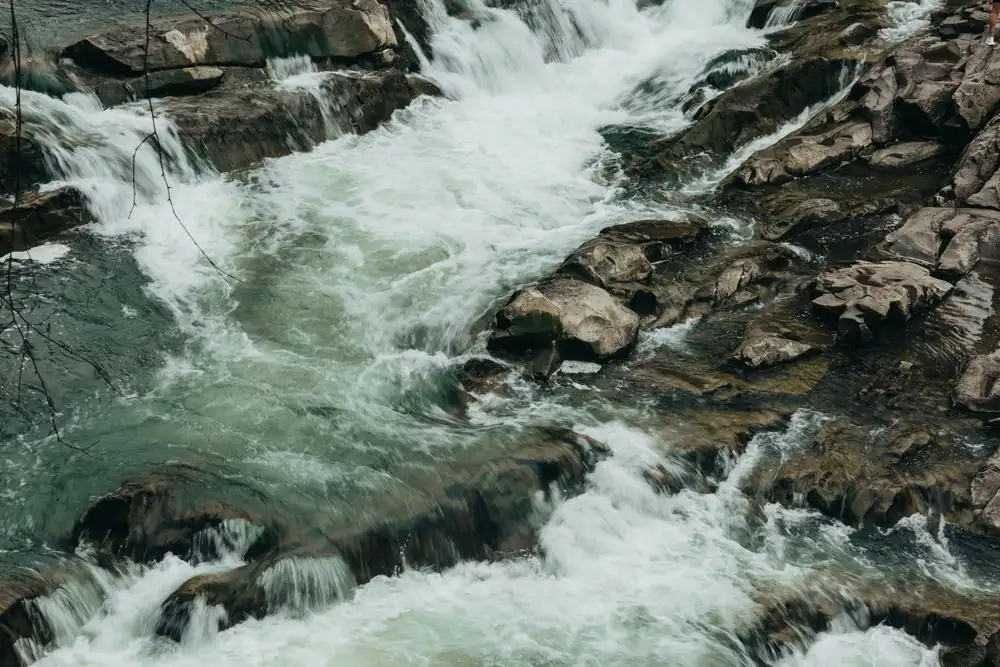
Photograph · source and license
The image, credit, reuse license, editorial context and delivered file are recorded in the exact Sites editorial review. This review is separate from the article’s canonical CIE assessment.
Image and publication standards →At a glance
- Combined pipes carry stormwater and wastewater together.
- The September 17, 2026 city update describes permanent tunnel lining and a summer 2027 completion target.
- The planned tunnel stores water during a surge and returns it for treatment when capacity is available.
In this story
One pipe, two kinds of water
Lynchburg’s combined sewer system carries household and business wastewater together with stormwater. During dry weather, the flow goes to the regional treatment facility before discharge to the James River.
During intense rain, the shared pipes can receive more water than they can carry. Overflow then takes a second route into nearby streams or the river, bringing untreated wastewater and street debris with it.
The city says approximately four percent of Lynchburg uses this combined collection system. That limited footprint helps explain why a citywide rainstorm and a particular sewer overflow are not identical events.
The relevant question is how much water reaches the combined network, where it arrives and whether the pipes and treatment system have room for it. Water outside that network follows other drainage routes.
An overflow count describes outlets or events; a volume describes the amount of water discharged. Closing many small outlets and managing a few large flows can produce different numerical results.
The city’s historic reductions and the tunnel’s projected reduction are therefore best understood as statements about water volume, not interchangeable counts of places.
The environmental problem includes more than visible litter. Lynchburg identifies bacteria and excess organic material among the concerns.
Organic loading can contribute to lower dissolved oxygen, creating stress for fish and other aquatic organisms. A river may look largely unchanged while receiving a pulse of material that affects the conditions living things experience.
Separation was an enormous construction job
The city’s history of the program describes work from 1979 through 2014 to divide combined sewers into separate stormwater and wastewater pipes. It reports spending about $237.8 million and closing 112 overflow points.
The city attributes an 80-percent reduction in overflow volume to that period. Those are program-history figures, not measurements of one storm in 2026.
A revised long-term plan, completed in 2015, adopted another approach for remaining flows: convey most of the mixed water to treatment. The city also acknowledged that extremely heavy rainfall could still produce some overflow because capturing every possible volume is not economically feasible.
That is a design tradeoff involving pipes, treatment capacity, rainfall and public expense. It makes a storage project understandable without treating storage as an unlimited vessel.
The tunnel changes the clock
In its September 17, 2026 update, Lynchburg announced the start of permanent concrete lining inside the Blackwater CSO Tunnel. The city described 4,744 feet of tunnel, between 70 and 120 feet underground, designed to store up to 4.7 million gallons of combined stormwater and sewage.
Crews were installing the lining in roughly 75-foot sections.
At one end, a diversion structure will send mixed flow into the tunnel during heavy rain. At the Seventh Street site, a pump station will return stored water to the wastewater system once capacity is available.
The key idea is delay. The rain’s peak can exceed immediate capacity; storage allows some of that peak to be handled later.
The city’s September update projected completion in summer 2027 and an overall 98-percent reduction in overflow volume compared with the program’s beginning. These remain expected outcomes.
For Lynchburg and neighboring communities sharing an interest in the James, the project illustrates a practical form of environmental engineering: making treatment space available by changing when water arrives, while recognizing that rainfall, construction and long-term operation still determine performance.
Sources & verification
Retrieved official explanation of combined-pipe operation, approximately 4% footprint and bacteria/organic loading; overview’s separate annual-volume claim not used.
Read the sourcePrimary city chronology supplies 1979–2014 separation work, spending, 112 closures, 80% reduction and 2015 alternate plan.
Read the sourceRetrieved dated update supplies construction phase, dimensions, 4.7-million-gallon storage, diversion/pumping sequence, expected 98% program reduction and 2027 target.
Read the sourceThis article was written with AI assistance from the linked sources. No firsthand interview or visit is implied. Source dates and limits are identified in the reporting. Advertising does not determine editorial coverage. Request a correction or read our standards.
EVERY NEIGHBOR HAS A VOICE
Keep the conversation going.
Share experiences, ask questions and link evidence for factual claims. Automated publication checks apply to each submitted version. Comments are independent community discussion, not submissions to a government body.
Sign in to join · freeCommunity standards