
Explainer Food · Nation
Bread color does not tell the whole-grain story
Ingredient wording explains more than a brown crust or a picture of wheat.
Checking whether this browser can read the story aloud.
Explore related topics
Sources & editorial review
Sites editorial review recorded for this exact revision. This AI-assisted article or learning resource includes source links and credited contextual imagery.
This is a local editorial review, not a canonical Cultural Imprint Engine assessment. No CIE score is claimed. Source review does not verify third-party playback, provider availability or image pixels.
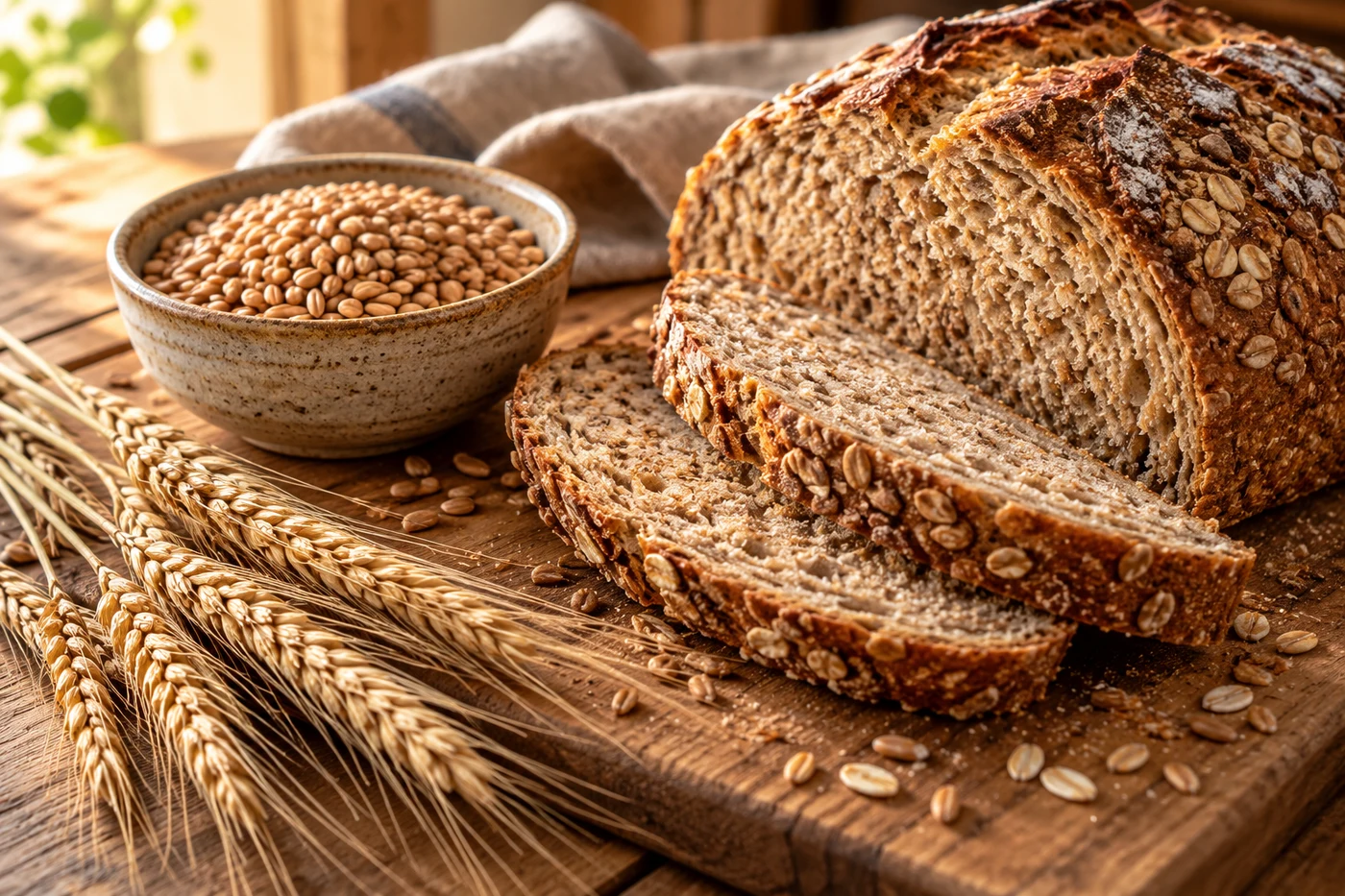
AI-generated illustration · source and license
The image, credit, reuse license, editorial context and delivered file are recorded in the exact Sites editorial review. This review is separate from the article’s canonical CIE assessment.
Image and publication standards →At a glance
- Whole grain refers to the parts of the grain retained.
- Read ingredient names rather than relying on color.
- Historical guidance should be identified by its date and status.
In this story
The kernel behind the phrase
A grain kernel includes bran, germ and endosperm. Whole-grain descriptions concern retaining those parts in their original proportions, whether the grain is intact or ground.
Refining can remove bran and germ. That makes whole wheat flour a more specific ingredient description than wheat flour alone.
FDA's February 2006 draft guidance discusses this terminology and examples such as rolled oats and whole wheat flour. The page remains explicitly labeled draft and nonbinding.
It is useful for understanding the agency's explanation of grain structure, but this article does not present its historical dietary targets as current requirements.
Examine a fictional pair
Imagine two loaves at a household table. Both are brown.
One ingredient list begins with whole wheat flour; the other begins with enriched wheat flour. Color alone did not reveal that distinction.
Neither fictional loaf has a price, nutrient panel or claimed local availability, so the example cannot determine which is the better purchase for a particular family.
VA's 2013 grain explainer also distinguishes grain parts and processing. Read an actual product's complete ingredient list and Nutrition Facts panel to answer further questions.
A front label can mention several grains without establishing that every grain ingredient is whole.
Make it a kitchen lesson
The same exercise works with oatmeal, pasta or cornmeal. Write the exact ingredient name beside the cooking directions, then ask what information is still missing.
How much will the household use? Does the product suit the recipe?
Are there ingredients a diner needs to avoid?
This approach gives children and adults a concrete way to connect a crop with a package. It also leaves room for preference, accessibility and household circumstances.
Learning ingredient vocabulary does not require declaring a food morally good or bad, or turning a dated federal article into personalized dietary advice.
Sources & verification
February 2006 draft, explicitly nonbinding and not for implementation; used for grain terminology only. Retrieved and checked against the available primary-source page or indexed official excerpt on October 3, 2026.
Read the sourceHistorical 2013 federal explainer; grain anatomy used, dated dietary recommendations not adopted. Retrieved and checked against the available primary-source page or indexed official excerpt on October 3, 2026.
Read the sourceThis article was written with AI assistance from the linked sources. No firsthand interview or visit is implied. Source dates and limits are identified in the reporting. Advertising does not determine editorial coverage. Request a correction or read our standards.
EVERY NEIGHBOR HAS A VOICE
Keep the conversation going.
Share experiences, ask questions and link evidence for factual claims. Automated publication checks apply to each submitted version. Comments are independent community discussion, not submissions to a government body.
Sign in to join · freeCommunity standards