
History Schools · County
Cedarbrook’s 1963 opening put modern architecture inside a segregated school system
Danville’s former elementary school records both a new building vocabulary and unequal access to education.
Checking whether this browser can read the story aloud.
Explore related topics
Sources & editorial review
Sites editorial review recorded for this exact revision. This AI-assisted article or learning resource includes source links and credited contextual imagery.
This is a local editorial review, not a canonical Cultural Imprint Engine assessment. No CIE score is claimed. Source review does not verify third-party playback, provider availability or image pixels.
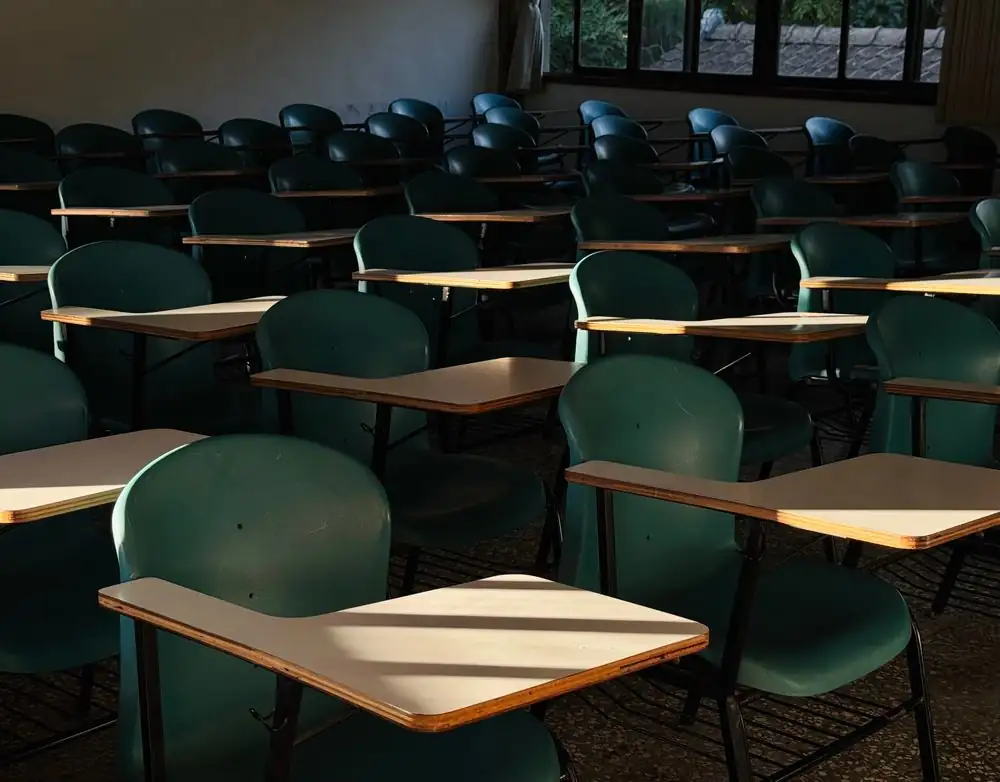
Photograph · source and license
The image, credit, reuse license, editorial context and delivered file are recorded in the exact Sites editorial review. This review is separate from the article’s canonical CIE assessment.
Image and publication standards →At a glance
- Cedarbrook was built in 1962–63 in the International Style.
- The nomination records its opening for white students.
- Later additions and a 1983 renaming formed separate chapters.
In this story
A school designed for a growing suburb
Cedarbrook Elementary School was constructed in Danville in 1962–63 on a ten-acre suburban site. Virginia DHR describes a one-story International Style building with strong horizontal lines, a flat roof and brick veneer.
Aluminum window banks, porcelain-enamel panels and glazed structural tile made its appearance markedly different from the monumental, classically styled school buildings of an earlier generation.
The building’s low form and broad windows connected school design with changing ideas about classrooms, construction materials and economical building after the Second World War. A school could look modern because of its arrangement and surfaces, without being a tall landmark.
Cedarbrook’s architecture made a public institution part of a residential setting rather than giving it the appearance of an older downtown courthouse or college hall.
Modern design did not mean equal access
The 2024 nomination states that Cedarbrook opened for white students in early 1963. That fact belongs beside its architectural description.
New materials and educational design did not remove the racial restrictions of the school system in which the building began its working life. A history that celebrates only the windows or the floor plan would omit an essential part of the institution’s original use.
Keeping these histories together avoids a misleading equation between modern appearance and social progress. A building could embody new teaching ideas while serving a segregated population.
The children excluded from its initial student body are therefore part of its history, even when the building inventory concentrates on physical features. Architecture records what was constructed; enrollment history helps explain whom that construction was intended to serve.
The building changed over time
A south wing added in 1969 gave the school an overall U-shaped arrangement. A gymnasium followed in the mid-1980s.
In 1983, Cedarbrook was renamed W. Townes Lea Elementary School in honor of a former superintendent.
These changes created a sequence of construction and naming decisions after the original opening, rather than one single event that fixed the institution’s identity forever.
DHR identifies Cedarbrook as the most intact of three Danville elementary schools designed between 1958 and 1969 by Lyles, Bissett, Carlisle and Wolff. That assessment concerns the survival of architectural features.
It is not a ranking of students, teachers or educational quality. A preserved window pattern and a child’s experience are different kinds of evidence, and each can matter without being substituted for the other.
Recognition preserved a complicated record
The National Park Service’s April 4, 2025 weekly list records Cedarbrook’s National Register listing on April 2. The listing documents a building’s historical and architectural importance; it does not certify that all the practices associated with its history were just.
Preserving this school can retain evidence of both design achievement and the segregated institution in which that design was first used.
For regional families, Cedarbrook offers a concrete way to discuss the difference between change in buildings and change in access. Its flat roof, window banks, additions and changing name belong to a long institutional life.
Its 1963 opening also belongs to the history of racial inequality. An honest account gives both chapters room, making the structure a place for fuller understanding rather than an uncomplicated symbol of progress.
A classroom’s historical meaning cannot be read from its surface alone. The same window bank can belong to an architectural story about light and materials and to an institutional story about who could enter.
Keeping those questions together gives the school a richer public value. It allows preservation to retain evidence of changing design without turning that evidence into a claim that the society using the building had already fulfilled the promises associated with public education.
Sources & verification
Register entry updated April 4, 2025; school built in 1962–63 and National Register listing April 2, 2025. Retrieved October 3, 2026. Primary administrative preservation record issued by Virginia DHR; the nomination includes original building inventory and documented historical research.
Read the source2024 nomination; original building survey and documented school construction and segregation history. Retrieved October 3, 2026. Primary administrative preservation record issued by Virginia DHR; the nomination includes original building inventory and documented historical research.
Read the sourceWeekly list dated April 4, 2025; records Cedarbrook’s April 2, 2025 listing. Retrieved October 3, 2026. Primary federal administrative record of National Register action; used only to identify the listing date, not as evidence of educational outcomes.
Read the sourceThis article was written with AI assistance from the linked sources. No firsthand interview or visit is implied. Source dates and limits are identified in the reporting. Advertising does not determine editorial coverage. Request a correction or read our standards.
EVERY NEIGHBOR HAS A VOICE
Keep the conversation going.
Share experiences, ask questions and link evidence for factual claims. Automated publication checks apply to each submitted version. Comments are independent community discussion, not submissions to a government body.
Sign in to join · freeCommunity standards