
Service guide People · Gretna
Proof a rehearsal score with the people who must read it
A MuseScore Studio exercise checks the music, layout and handoff as separate tasks.
Checking whether this browser can read the story aloud.
Explore related topics
Sources & editorial review
Sites editorial review recorded for this exact revision. This AI-assisted article or learning resource includes source links and credited contextual imagery.
This is a local editorial review, not a canonical Cultural Imprint Engine assessment. No CIE score is claimed. Source review does not verify third-party playback, provider availability or image pixels.
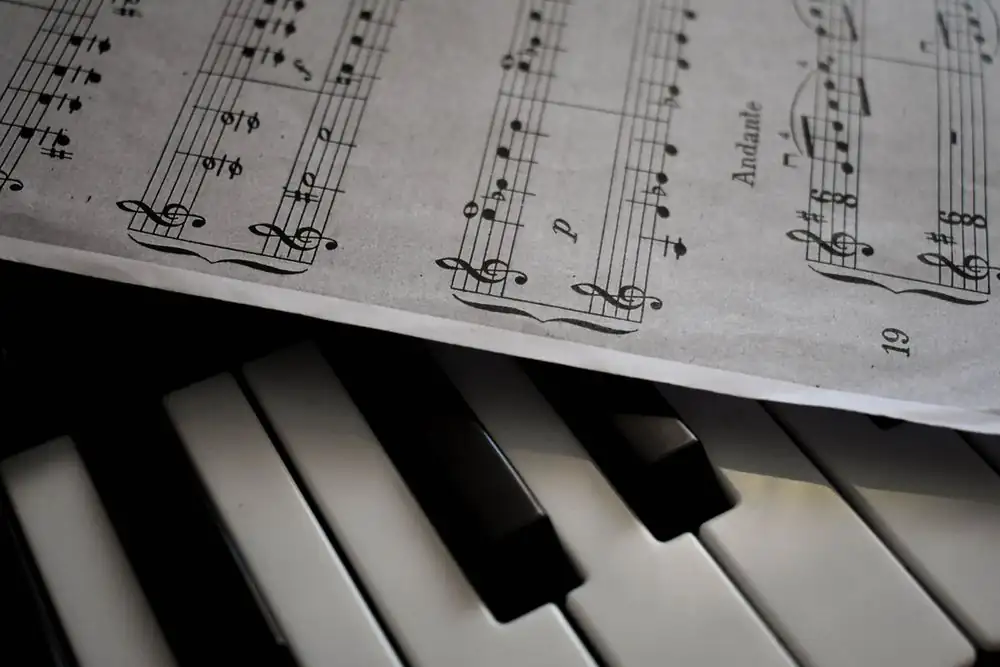
Photograph · source and license
The image, credit, reuse license, editorial context and delivered file are recorded in the exact Sites editorial review. This review is separate from the article’s canonical CIE assessment.
Image and publication standards →At a glance
- Enter a short original melody for practice.
- Check notation separately from playback.
- Open the exported score before giving it to performers.
In this story
Start with a small original phrase
Imagine preparing an original eight-measure tune for two adult players. This is a hypothetical notation exercise, not a published arrangement of a familiar song.
Write the intended pitches and rhythms in a notebook and decide which player carries the melody. Giving the score a modest purpose keeps the first proofreading pass manageable.
MuseScore Studio’s first-score handbook explains score setup, note entry and exports. Its export guidance distinguishes formats that preserve visual presentation from formats carrying other musical information.
Use the documentation appropriate to your installed version, and choose the output according to what the receiving musician needs.
Proof the musical content
Read each measure against the original notebook. Check the key and time signatures, note durations, rests and any accidental that changes the pitch.
A passage that sounds plausible during playback may still contain a note you did not intend. If the exercise includes words, check their spelling and placement independently from the melody.
Ask someone to count through the phrase slowly. If they stop in the same place twice, investigate the notation rather than blaming the reader.
Sometimes the music needs a clearer rhythmic grouping; sometimes the phrase itself needs revision. Keep those two decisions separate in your notes.
Proof what a player sees
Print or view the score at the size likely to be used in rehearsal. Check that the title, instrument names and page numbers are clear.
Look for crowded symbols and a turn that would fall at an awkward moment. A beautiful screen layout can become uncomfortable when reduced to a small page or viewed from a music stand.
In this exercise, let each player mark one place where they had to guess. Ask what they needed there: a rehearsal letter, a clearer cue or a better explanation of the form.
Only add a marking when it solves an identified problem. Excess instructions can make a short tune harder to read.
Ask the players whether the first page supplies enough information to begin without your spoken explanation. An unclear opening instruction is a useful finding.
Add the minimum clarification that resolves it, then check that the revision agrees with the music and does not contradict another marking.
Choose the receiving format
A PDF can serve as a reading copy, while an editable interchange file may be needed for someone continuing the notation work. MIDI does not carry the score’s visual formatting in the same way.
Do not assume that one export will answer every request.
Send a small manifest identifying the title, revision date, intended instruments and files included. If you supply a listening reference, label it as a reference rather than a definitive performance.
Make sure the music and PDF belong to the same revision. Conflicting copies at a rehearsal can waste time even when each file opens correctly.
Treat the rehearsal as a proof
Use the first play-through to collect concrete observations: a missed entrance, an unclear repeat or a line that exceeds the intended player’s comfortable range. Agree on a correction, then revise the master and export a newly dated copy.
Ask participants to retire the earlier reading copy so the next session starts with one version.
Keep authorship and permissions clear. This assignment uses original music, and it does not provide clearance to arrange or distribute another writer’s composition.
The result is a score whose musical decisions and presentation have both been reviewed by the people expected to use it.
Sources & verification
Score setup, note entry and export options. Checked October 3, 2026.
Read the sourcePDF, editable interchange and MIDI carry different information. Checked October 3, 2026.
Read the sourceThis article was written with AI assistance from the linked sources. No firsthand interview or visit is implied. Source dates and limits are identified in the reporting. Advertising does not determine editorial coverage. Request a correction or read our standards.
EVERY NEIGHBOR HAS A VOICE
Keep the conversation going.
Share experiences, ask questions and link evidence for factual claims. Automated publication checks apply to each submitted version. Comments are independent community discussion, not submissions to a government body.
Sign in to join · freeCommunity standards