
Explainer Family · Virginia
From a wooden ship to a fossil cast: how Martinsville’s museum can make family science tangible
A new $5,000 grant announcement leads into the Virginia Museum of Natural History’s specific learning spaces, specimen work and routes into regional classrooms.
Checking whether this browser can read the story aloud.
Explore related topics
Sources & editorial review
Sites editorial review recorded for this exact revision. This AI-assisted article or learning resource includes source links and credited contextual imagery.
This is a local editorial review, not a canonical Cultural Imprint Engine assessment. No CIE score is claimed. Source review does not verify third-party playback, provider availability or image pixels.
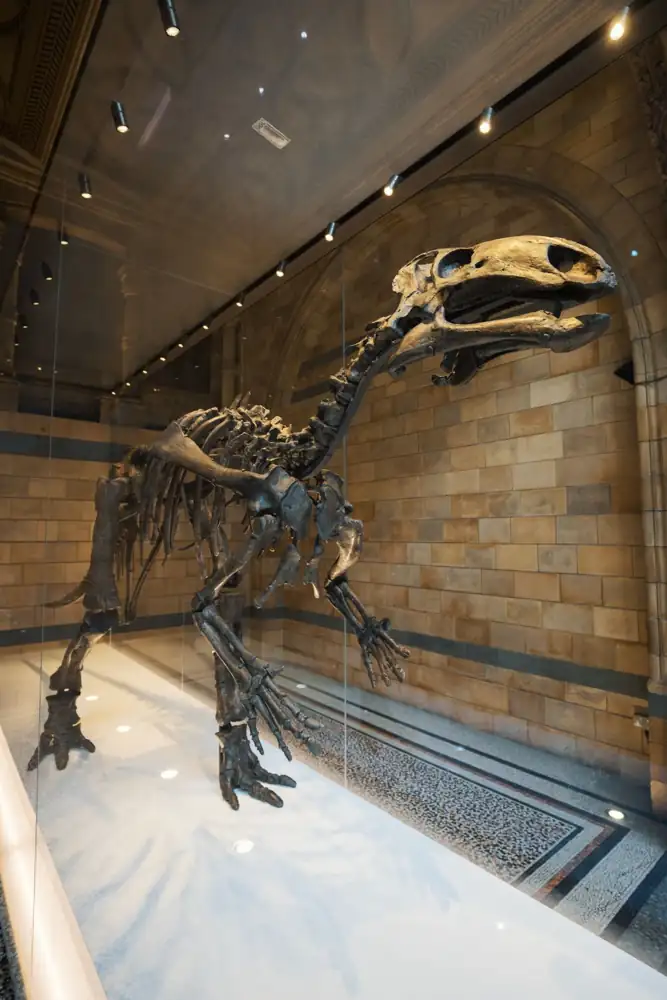
Photograph · source and license
The image, credit, reuse license, editorial context and delivered file are recorded in the exact Sites editorial review. This review is separate from the article’s canonical CIE assessment.
Image and publication standards →In this story
A new announcement with a precise limit
On October 5, 2026, the Virginia Museum of Natural History announced on its official website that a $5,000 grant from the Monogram Foods Loves Kids Foundation would support educational experiences for local and regional students. The museum is at 21 Starling Avenue in Martinsville.
That is a concrete new development for a regional institution, but the headline alone does not establish which individual family will receive assistance, how many places remain or whether a particular class has been booked.
The opportunity is worth understanding through the museum’s existing education infrastructure. Exhibits, collections, group programs and off-site teaching offer different ways to encounter science.
A family choosing among them is making a decision about format, time, cost and the kind of questions a learner is ready to explore. Treating every option as an interchangeable field trip hides those differences.
This article examines published museum descriptions and offers original ways to use them. It does not enroll a child, confirm a scholarship award or evaluate a private student.
The grant is reported at the level the official announcement supports. Families and educators can then approach the museum with a specific question rather than assuming the announcement is a universal free-admission offer.
Discovery Reef makes room for play
The museum’s Discovery Reef page describes the Hooker Furniture Discovery Reef as a hands-on play and discovery space. A wooden ship with multiple decks, climbing areas and an interior play area is its centerpiece; books, games and puzzles provide additional activities.
The stated target is children eight and under, while the interactive elements accommodate other ages, including parents. Those details describe a learning environment, not a promise of a guided lesson every time someone enters it.
An adult can use that environment without turning play into an examination. Notice what a learner chooses first, what requires cooperation and what causes a pause.
A question about how to reach a place on the ship invites spatial reasoning; a question about why a puzzle piece fits invites attention to shape. These are possible family conversations, not measured outcomes from a study of this particular exhibit.
The distinction is useful because young children do not have to begin a museum visit with a long sequence of labels. Physical exploration can supply a common experience that supports conversation later.
A successful outing may involve fewer objects and more time in one space. The target age helps with planning, while supervision and the needs of the individual group still require adult judgment.
The label changes what a fossil can tell you
VMNH’s Research and Collections page explains that the information accompanying a scientific specimen is central to its research value. Its collections span fields including paleontology, recent invertebrates, archaeology, mammalogy and geology.
The point is not merely that the institution owns many objects. A specimen and its associated information form a relationship that allows someone else to ask a meaningful scientific question.
For a family, this can be demonstrated with a hypothetical comparison. Imagine two similar stones on a table.
One has a documented place, collection date and identification; the other has no history attached. Both might provoke curiosity, but they support different claims.
The first can be connected to a research context. The second requires additional work before it can be treated as evidence about a locality or geological layer.
This example is a reasoning exercise, not permission to collect material anywhere. The broader lesson is about observation and context.
Recording where something was seen, without removing it or revealing a private location, helps separate an interesting object from an unsupported story. A museum label models how curiosity becomes a question other people can examine rather than only a memory held by one observer.
A cast is doing a different job from an original
The museum’s Fossil Overlook description explicitly combines fossils with re-creations of ancient life. It identifies a cast display and scaled flesh model of Dunkleosteus and a life-size cast skull of Tylosaurus.
An exhibit can therefore contain several kinds of objects that serve different purposes. Calling everything a dinosaur fossil would miss both biological differences and the distinction between preserved evidence and a made teaching object.
An original fossil records surviving material or traces from the past. A cast can communicate form without requiring the original object to be handled or transported.
A flesh model adds a reconstruction of appearance. A useful family conversation asks which of those jobs an object is doing before asking whether it is real.
Real as an educational model and original as ancient material are different descriptions.
The museum page also identifies a Green River Formation slab representing several fossil fish species. That display’s source region is in the western United States.
An object exhibited in Martinsville does not automatically come from Martinsville. Making that distinction is part of learning geography alongside natural history.
It prevents the excitement of discovery from turning into a false claim about the rocks under a visitor’s own neighborhood.
Models connect a visible landscape with invisible processes
The How Nature Works gallery is described in two parts: Rocks and Life. Its geological models connect moments in Virginia’s past with processes occurring elsewhere today.
The Life section includes taxidermy mounts from Virginia and other parts of the world. Those choices let a visitor compare scales of time and geography inside one institution, but they also require attention to which places and processes each display actually represents.
A model is powerful because it makes a relationship visible that would otherwise be hard to watch. Continental movement cannot be observed during a short visit in the same way a person observes a leaf falling.
A model compresses time, changes scale and selects features. The educational question becomes what the model emphasizes and what it necessarily leaves out.
That is not a reason to dismiss it; it is a way to use it intelligently.
A family might select one Virginia landscape model and describe its visible features before reading the explanation. Afterward, compare the initial description with the process the label names.
The difference shows how explanation adds to observation. It also demonstrates that an attractive surface and a causal account are separate steps.
Neither guessing quickly nor memorizing every label is required to participate.
The group visit is a distinct product
The museum’s Self-Guided Exhibit Tours and Programs page describes gallery exploration, custom scavenger hunts and optional classroom programming aligned with Virginia learning standards. It says reservations are required at least two weeks in advance and that typical programs last twenty to sixty minutes depending on other requested activities.
Homeschool groups and other educational classes are included among the groups welcome to inquire.
That description should not be converted into a claim that an ordinary family ticket includes a reserved classroom session. General admission, a group visit and an optional education program have different arrangements.
The published group fee text also contains a chaperone description that needs direct clarification rather than an invented interpretation. A responsible plan confirms the current offer with the museum before money or transportation is committed.
For an organizer, the meaningful first question is what the learners should be able to explore. A fossil program might emphasize comparing evidence; an engineering program might emphasize testing a design.
Once the purpose is clear, the organizer can ask about the format, group size, accessibility, timing and fee. This order keeps logistical planning connected to learning rather than treating the museum as an interchangeable location for a bus trip.
The museum can travel, but the service area matters
VMNH’s Outreach Programming page lists Southern Virginia coverage that includes Danville, Franklin, Halifax, Henry, Martinsville, Patrick and Pittsylvania. It describes classroom-based programs delivered away from the museum.
The page publishes session fees, says public schools in Martinsville and Henry County receive discounted education fees and notes a mileage charge outside that area. These are source-defined boundaries, not an assurance that every location can receive every program on demand.
For a school or community group in Pittsylvania, the distinction can change the practical choice. Transportation to Martinsville and a program brought to a local classroom involve different costs and different experiences.
One allows learners to move through galleries; the other can focus a group on a selected activity in a familiar room. Neither is automatically better.
Compare the learning purpose and complete arrangements instead of assuming that the nearest or least expensive option meets every need.
The museum’s listed Central Virginia outreach is a separate region with its own published programming information. A service map should retain that separation.
A local organization can ask which curriculum, materials and dates are available to it, but this article has not made that request or obtained a confirmed booking.
Different ages can share a question without sharing a task
The museum’s education overview describes Doodle Bugs for ages three through five, homeschool programming and distance learning among its offerings. Those categories show that the institution does not treat all learners as one uniform audience.
Availability, schedules and registration still belong with the current program pages and staff; a category on an overview page is not an open place in a specific session.
A mixed-age family can use a similar principle during an ordinary visit. Give everyone a common object, then vary the question.
A younger learner might describe a shape or choose a visible difference. An older learner might ask what evidence supports the reconstruction or how the object was classified.
An adult can participate without claiming to know the answer in advance. Shared attention is the common element; identical worksheets are not required.
The key is to keep the questions connected to something actually present. Asking for a fact absent from the label can make a learner feel that the museum is a guessing game.
Asking what would help answer an unresolved question demonstrates another part of science: deciding what additional information is needed. That process can continue after the visit without requiring the disclosure of a child’s performance or personal history.
Access is a household decision, not a headline number
The museum’s official visitor information currently lists regular Tuesday through Saturday hours of 10 a.m. to 4 p.m.; Sunday opening is seasonal between Memorial Day and Labor Day weekends, and Monday is closed. Published admission categories include adult and reduced prices plus listed free-admission categories.
A family should confirm the current conditions of any membership, ASTC Passport or EBT benefit with the museum before travel rather than assume every benefit applies in the same way.
Keeping those distinctions visible makes the opportunity more usable. A price quoted for one age category is not the cost of an entire household.
Transport, food, time away from work and the needs of a group also shape access, even when admission is free. The new grant announcement does not supply enough information to calculate a household’s final expense or promise aid.
It supplies a reason to ask what support is available through the named education initiative.
Privacy belongs in that planning. Eligibility questions should go through the museum’s official route; family documents should not be posted in a public comment thread to demonstrate need.
A local publication can explain the opportunity while leaving personal circumstances and any individual approval with the family and the institution.
A small record can carry the visit home
The most useful souvenir from a science visit may be a short description rather than a large amount of collected information. Choose one object or model and record what was observed, what the museum label established and what remains a question.
A sketch can distinguish visible features from imagined ones. A few accurate notes can preserve the source of a fact that would otherwise blur into a confident retelling.
Suppose a learner remembers a dramatic cast skull. The follow-up is to identify the animal, the object type and the evidence described by the institution.
That is a better starting point than repeating that a huge dinosaur lived in Martinsville. If an online source later adds context, note where it came from.
This hypothetical exercise joins the excitement of an exhibit to the slower practice of checking a claim.
The museum’s new support announcement matters because education needs routes into real communities. Its lasting value will be understood through actual programs and participation, not by converting a grant headline into invented outcomes.
For families across the region, the available next step is concrete: explore the official learning options, choose a suitable format and ask a question that an object, model or educator can help investigate.
Sources & verification
Primary source checked October 10, 2026. Source dates, documented facts and limitations are identified in the article; interpretation and hypothetical examples are separate.
Read the sourcePrimary source checked October 10, 2026. Source dates, documented facts and limitations are identified in the article; interpretation and hypothetical examples are separate.
Read the sourcePrimary source checked October 10, 2026. Source dates, documented facts and limitations are identified in the article; interpretation and hypothetical examples are separate.
Read the sourcePrimary source checked October 10, 2026. Source dates, documented facts and limitations are identified in the article; interpretation and hypothetical examples are separate.
Read the sourcePrimary source checked October 10, 2026. Source dates, documented facts and limitations are identified in the article; interpretation and hypothetical examples are separate.
Read the sourcePrimary source checked October 10, 2026. Source dates, documented facts and limitations are identified in the article; interpretation and hypothetical examples are separate.
Read the sourcePrimary source checked October 10, 2026. Source dates, documented facts and limitations are identified in the article; interpretation and hypothetical examples are separate.
Read the sourcePrimary source checked October 10, 2026. Source dates, documented facts and limitations are identified in the article; interpretation and hypothetical examples are separate.
Read the sourcePrimary source checked October 10, 2026. Source dates, documented facts and limitations are identified in the article; interpretation and hypothetical examples are separate.
Read the sourceThis article was written with AI assistance from the linked sources. No firsthand interview or visit is implied. Source dates and limits are identified in the reporting. Advertising does not determine editorial coverage. Request a correction or read our standards.
EVERY NEIGHBOR HAS A VOICE
Keep the conversation going.
Share experiences, ask questions and link evidence for factual claims. Automated publication checks apply to each submitted version. Comments are independent community discussion, not submissions to a government body.
Sign in to join · freeCommunity standards