
Explainer Conservation · Virginia
A pine forest returns on several clocks: Sussex’s longleaf restoration story
Planting at Big Woods, conservation work at Joseph Pines and habitat management at Chub Sandhill show why restoring a forest is more than adding trees.
Checking whether this browser can read the story aloud.
Explore related topics
Sources & editorial review
Sites editorial review recorded for this exact revision. This AI-assisted article or learning resource includes source links and credited contextual imagery.
This is a local editorial review, not a canonical Cultural Imprint Engine assessment. No CIE score is claimed. Source review does not verify third-party playback, provider availability or image pixels.
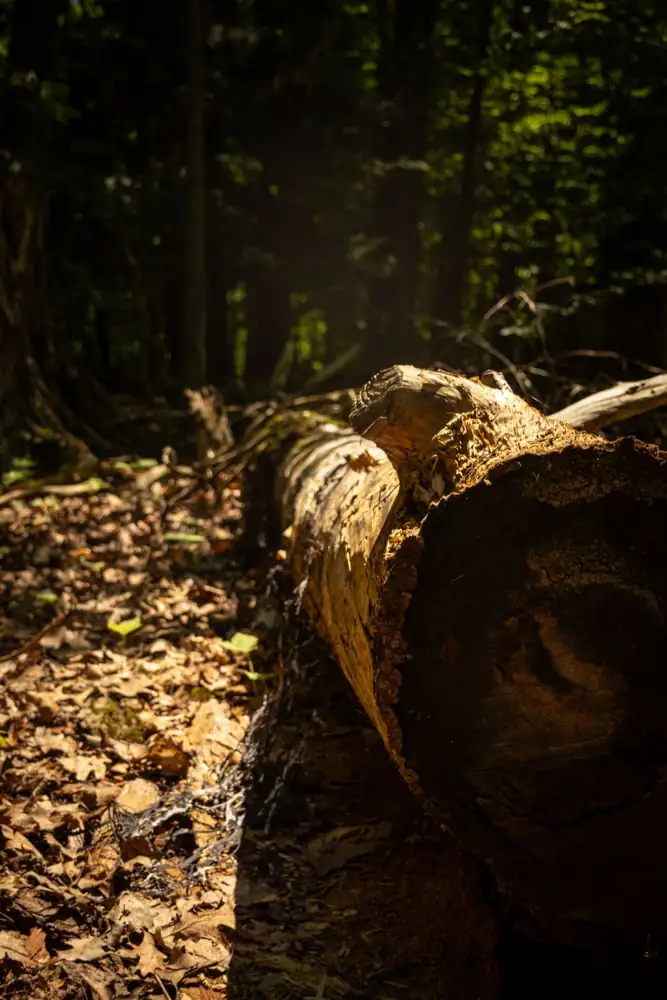
Photograph · source and license
The image, credit, reuse license, editorial context and delivered file are recorded in the exact Sites editorial review. This review is separate from the article’s canonical CIE assessment.
Image and publication standards →In this story
The tree is only one part of the return
A planted pine can be counted in a day. A functioning habitat asks a longer question.
In Sussex County, state forestry and wildlife accounts describe efforts to restore longleaf pine and the landscape associated with it. Their reports connect planting to seed sources, land protection, ongoing management and wildlife.
These are documented projects at specific southeastern Virginia sites. This article does not imply that longleaf restoration is appropriate for every yard or woodland across the wider Southside region.
Longleaf is useful here as a way to examine what people mean by restoration. Replacing a missing tree species is one task.
Recovering the conditions that allow it and associated plants or animals to persist is another. A planting ceremony may mark the beginning of work without measuring its eventual success.
The distinction matters to residents because environmental projects are often summarized by the most easily photographed action, while the continuing work receives less public attention.
The Sussex cases allow a more patient story. Big Woods supplies a documented planting effort.
Joseph Pines shows how an agreement protecting land can support restoration. Chub Sandhill connects reintroduction with a managed preserve.
Wildlife reports add evidence that habitat is being used, while also recording setbacks. These pieces do not create a single score for the county.
They reveal several kinds of evidence, each answering a different question about how a damaged or diminished landscape can recover.
Native geography sets the boundary
Virginia's Department of Forestry describes its work with the Longleaf Cooperators of Virginia to conserve and restore the species within its native range. The department's diminished-species material identifies the scarcity of the native Virginia seed source, essentially limited to one Suffolk site.
That information explains why seed origin belongs in the project story. A seedling's label alone does not establish that it represents the local population managers are trying to conserve.
There are two geographical boundaries to keep visible. One is the species' historical setting.
The other is the location of a particular intervention. A reader in Emporia may encounter the Sussex story as nearby regional coverage, but that does not move a planting into Greensville County.
Likewise, a discussion of restoration in southeastern Virginia does not prove that the same approach applies to a property farther inland. This article's locality links support regional discovery; the documented projects remain in their stated locations.
That precision is a form of environmental care. An appealing ecological idea can become a poor decision if detached from site conditions.
The public story should therefore explain what managers are trying to restore before celebrating how much land is involved. Habitat, species origin, soils, water and ongoing management make a place more specific than a point on a map.
No planting prescription is offered here. Site decisions belong with qualified land managers and the applicable conservation or forestry guidance.
Big Woods makes planting a documented stage
A December 2020 forestry field account describes longleaf planting at Big Woods State Forest and places it within more than two decades of cooperative restoration work. Its stated hope was that adding the species would increase plant and animal diversity at the site.
The wording matters: an anticipated benefit is not a measured result. The account documents an intervention and its purpose, without giving this article a present-day survival rate for those seedlings.
A useful way to read the event is to ask which clock it starts. Planting starts a biological clock for the young trees, a management clock for their care, and a monitoring clock for checking outcomes.
Those clocks move together but do not produce the same kind of evidence. A dated project photograph can verify that work occurred.
A later observation can show what survived. A habitat survey can address a broader question about ecological change.
None of those records can silently stand in for all the others.
This is why the article avoids presenting a seedling total as restored habitat. A total may be important to a project, but it says little by itself about the condition of the ground layer, the spacing of trees or use by wildlife.
The Big Woods account offers a stronger public narrative when its planting is treated as a step in an established effort, rather than a claim that the full forest returned on the day people finished putting seedlings into the ground.
The different clocks also explain why a public update can be accurate without being final. A forestry account may describe work completed on a particular day; a wildlife account may describe an observation years later.
They need not report the same unit or cover the same parcel to be useful, but their relationship should be established rather than assumed. A report about the state forest cannot silently become a result for an adjacent wildlife-management area.
Similarly, a project with a familiar shared name may contain separate activities whose boundaries matter. The reader gains more from a small number of clearly located milestones than from an impressive total made by combining unlike records.
Conservation work benefits when its public history remains traceable at the level where the work actually occurred.
Joseph Pines shows the work behind a boundary
In February 2021, DOF reported an acquisition that expanded an existing conservation easement at Joseph Pines Preserve in Sussex County, undertaken with Meadowview Biological Research Station. The announcement described plans to harvest an existing loblolly plantation and convert the area to native Virginia longleaf pine.
The dated statement documents the protection arrangement and intended restoration. It does not establish that every planned change has been completed by October 2026.
Land protection and ecological restoration are related but different achievements. An easement can create a framework within which work becomes possible or more durable.
It cannot itself grow a tree or establish a population of a rare species. Similarly, an operational change within a forest does not by itself explain the agreement that protects the land.
The Joseph Pines account is useful because it exposes this relationship instead of reducing the project to acreage alone.
For communities, that distinction helps evaluate an announcement without cynicism or automatic celebration. Protecting the opportunity to restore a site can be valuable even before the ecological result is visible.
The next question is what action followed and what evidence describes it. A dated plan should remain labeled as a plan until a later record supports implementation.
This article has not inspected a current easement instrument or conducted a site survey; it therefore does not claim new restrictions, visitor rights or measured restoration outcomes for Joseph Pines.
Chub Sandhill joins reintroduction to a place people can understand
DCR's preserve description identifies longleaf reintroduction at Chub Sandhill beginning in 2007. DWR's visitor account describes mixed hardwood forest and the restoration project, with a trail leading to a platform overlooking the Nottoway River.
These accounts connect habitat work to a landscape that can be explained through several features rather than through a single species. The page descriptions are not a guarantee that a trail is open or unchanged on the day a reader plans a trip.
A preserve contains more than its restoration target. The river setting, existing forest and managed areas form relationships that matter to its interpretation.
A visitor looking only for young longleaf could miss why managers are caring for the broader place. This is an interpretive observation, not a new vegetation inventory.
It encourages attention to the setting in which restoration occurs, while avoiding claims about particular plants or animals that this article has not observed or independently surveyed.
Public access also has its own clock. DCR maintains information about preserve closures, including closures associated with management activities such as prescribed burning.
A place can be publicly valued while temporarily unavailable for entry. Visitors should check the current agency notice and follow posted restrictions instead of assuming that a historic access description overrides a closure.
Supporting restoration includes respecting the conditions under which managers can carry out the work, not merely reaching the most attractive viewpoint.
Fire belongs to professional management, not imitation
A Forest Service research paper on longleaf ground-layer vegetation examines how fire frequency affects these habitats. Its existence underlines that the question is more detailed than whether a forest should ever burn.
Frequency and site conditions matter. DCR's closure information supplies a practical counterpart: prescribed management can require excluding visitors for safety.
This article summarizes those concepts; it does not supply ignition instructions, burn intervals or permission to carry out a fire.
For a public audience, the term restoration can sound like leaving land untouched. The longleaf examples show why that assumption is incomplete.
Some conservation goals require repeated intervention by trained personnel. A managed action can be intended to maintain conditions for particular ecological communities, while an unmanaged disturbance can produce different consequences.
Recognizing the distinction does not mean that every intervention succeeds. It means that the purpose, method, authority and observed outcome all deserve their own explanation.
The public communication challenge is to make that ongoing work legible without romanticizing risk. A smoke plume or a closure can alarm someone who has not seen the management notice.
An accurate explanation should name the agency and the dated activity when verified, while avoiding a guess about an unidentified fire. Conversely, an old photograph of a prescribed burn is not evidence about a current incident.
Time and identity matter as much here as the ecological reason for using a particular management tool.
Wildlife reports provide both progress and uncertainty
DWR's 2023 account describes a banded male red-cockaded woodpecker discovered with an active cavity at Big Woods Wildlife Management Area in 2017, originating from the Piney Grove population. A separate 2021 report explains how banding nestlings allows biologists to follow movements and status.
These are specific historical observations. They do not give this article a current population total or establish that every nearby patch of pine supports the species today.
The evidence has a chain: an identified bird, an observation at a location, and a relationship to earlier monitoring. That chain is stronger than an unverified social-media caption because it can connect an animal's presence to a documented history.
Yet even strong evidence has limits. Finding an active cavity is one observation; confirming survival, reproduction and sustained use over time requires additional work.
The story becomes more informative when those stages remain separate instead of being compressed into a generic success claim.
DWR's reporting also includes setbacks in nesting outcomes. This article does not repeat unverified present conditions from an old report or imply that every effort ended successfully.
The existence of such monitoring is itself important: conservation evidence includes losses and uncertainty as well as achievements. A public narrative that allows only celebratory numbers would make it harder to understand how managers learn and adapt.
The Sussex story deserves the same honesty about what has been observed, what was intended and what still requires a later check.
The connected landscape needs a connected account
Big Woods State Forest, Big Woods Wildlife Management Area, Piney Grove and Joseph Pines are not interchangeable labels. They involve different places, ownership or management arrangements, and public-access conditions.
DWR's dated viewing guidance for Big Woods explicitly instructed people to respect protected boundaries and avoid recorded calls used to attract birds. Its principle remains clear: wildlife interest does not authorize disturbance.
Current access details should be confirmed with the responsible agency before a visit.
A connected habitat story also should not become a promotional promise about a visitor's experience. A person may not see a target bird, and the absence of a sighting does not prove a restoration project failed.
Wildlife movement, observation conditions and restrictions all shape what a visitor encounters. The monitoring record and the casual visit answer different questions.
This article offers original interpretation of the official cases, not a field survey, a guaranteed wildlife itinerary or a current statement of permitting requirements.
The central lesson from Sussex is that restoration is a continuing relationship between place, species, management and evidence. Protection can secure the opportunity; planting can begin a change; professional care can maintain needed conditions; monitoring can show both progress and problems.
Those stages deserve to be reported on their own dates. For the wider Southside community, a more complete account can support conservation without inventing results or carrying a technique beyond the geography where its suitability has actually been established.
Sources & verification
Primary source checked October 10, 2026. Source dates, documented facts and limitations are identified in the article; interpretation and hypothetical examples are separate.
Read the sourcePrimary source checked October 10, 2026. Source dates, documented facts and limitations are identified in the article; interpretation and hypothetical examples are separate.
Read the sourcePrimary source checked October 10, 2026. Source dates, documented facts and limitations are identified in the article; interpretation and hypothetical examples are separate.
Read the sourcePrimary source checked October 10, 2026. Source dates, documented facts and limitations are identified in the article; interpretation and hypothetical examples are separate.
Read the sourcePrimary source checked October 10, 2026. Source dates, documented facts and limitations are identified in the article; interpretation and hypothetical examples are separate.
Read the sourcePrimary source checked October 10, 2026. Source dates, documented facts and limitations are identified in the article; interpretation and hypothetical examples are separate.
Read the sourcePrimary source checked October 10, 2026. Source dates, documented facts and limitations are identified in the article; interpretation and hypothetical examples are separate.
Read the sourcePrimary source checked October 10, 2026. Source dates, documented facts and limitations are identified in the article; interpretation and hypothetical examples are separate.
Read the sourcePrimary source checked October 10, 2026. Source dates, documented facts and limitations are identified in the article; interpretation and hypothetical examples are separate.
Read the sourcePrimary source checked October 10, 2026. Source dates, documented facts and limitations are identified in the article; interpretation and hypothetical examples are separate.
Read the sourcePrimary source checked October 10, 2026. Source dates, documented facts and limitations are identified in the article; interpretation and hypothetical examples are separate.
Read the sourceThis article was written with AI assistance from the linked sources. No firsthand interview or visit is implied. Source dates and limits are identified in the reporting. Advertising does not determine editorial coverage. Request a correction or read our standards.
EVERY NEIGHBOR HAS A VOICE
Keep the conversation going.
Share experiences, ask questions and link evidence for factual claims. Automated publication checks apply to each submitted version. Comments are independent community discussion, not submissions to a government body.
Sign in to join · freeCommunity standards